

Prime Cost Tracking: The #1 Restaurant Metric | KYN
 Sep 12,2026
What Is Prime Cost in a Restaurant – And Why It's the #1 Metric to Track
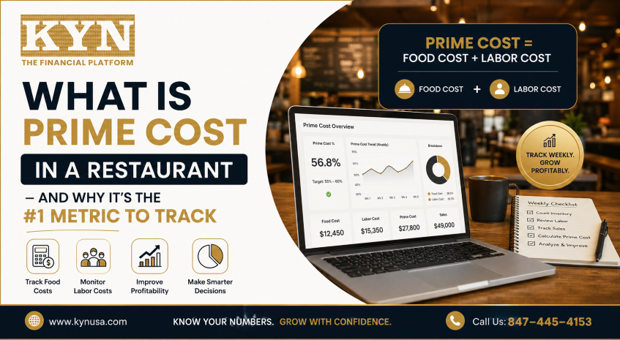
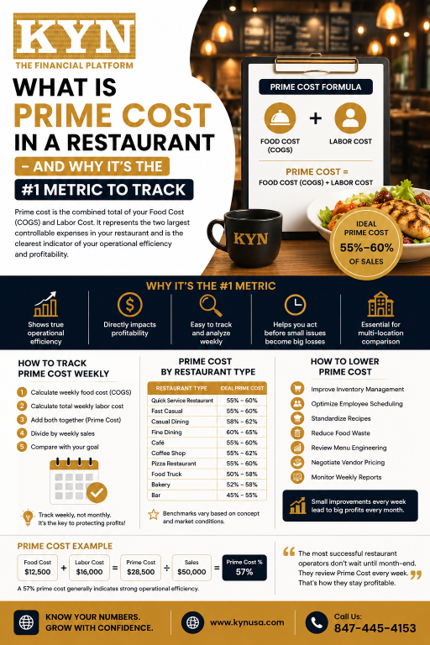
Prime cost is the total of a restaurant's food and beverage costs (COGS) plus total labor cost. Healthy restaurants keep prime cost between 55% and 65% of sales — aiming at or under 60%. Tracked weekly, it is the clearest early signal of whether your restaurant is protecting its profit.
Running a successful restaurant isn’t just about serving great food. Behind every profitable restaurant is one habit that separates thriving operators from struggling ones: weekly prime cost tracking.
Many owners watch total sales, or wait for the month-end P&L. Neither tells you how efficiently the restaurant actually ran this week. Prime cost does. At KYN | Know Your Numbers — a financial performance platform built by operators who have managed 170+ restaurant locations — prime cost is the first number we put in front of every restaurant owner, every single day.
Whether you run a quick-service restaurant, café, food truck, pizzeria, or fine-dining room, this guide covers why prime cost is the most important restaurant metric, how to track prime cost weekly, healthy prime cost benchmarks by restaurant type, and how to lower prime cost without cutting quality.
What Is Prime Cost?
Prime cost = food & beverage cost (COGS) + total labor cost. COGS covers everything you sell — food, beverages, packaging, and disposables tied to serving. Labor covers every payroll dollar: wages, salaries, payroll taxes, benefits, and overtime, front of house and back. Together, they are the two largest expenses you can actually control week to week.
Need the full calculation walkthrough with a worked example? Our complete guide — Restaurant Prime Cost: Formula, Examples & Benchmarks — covers it step by step. This article is about what to do with the number: tracking it weekly and acting on it.
Why Is Prime Cost the Most Important Restaurant Metric?
Sales tell you how busy you were. Profit tells you what was left — a month later. Prime cost tells you, while there’s still time to act, how efficiently the operation converted sales into money you keep. If prime cost runs too high, growing sales alone will not fix profitability. Compare two restaurants in the same week:
| Restaurant A | Restaurant B | |
|---|---|---|
|
Weekly sales |
$100,000 |
$90,000 |
|
Prime cost |
Prime cost |
$52,000 (58%) |
|
Left for rent, utilities, marketing, insurance — and profit |
$20,000 |
$20,000 |
Restaurant B earns nearly twice as much on lower sales. That’s why experienced operators put prime cost ahead of top-line revenue. The National Restaurant Association projected record industry sales of $1.5 trillion in 2025 — yet typical restaurant margins remain in the single digits. Volume doesn’t protect profit. Cost control does.
Why Should You Track Prime Cost Weekly?
Most restaurants review costs when the month-end financials arrive. By then, the damage is weeks old: if food cost spiked in week one, discovering it 30 days later means a full month of lost profit that no report can bring back.
Weekly prime cost tracking lets you:
- Catch food waste and portioning drift within days
- Spot labor scheduling problems before the next schedule is written
- Surface inventory issues — spoilage, theft, recording errors — while the trail is fresh
- React before a bad week becomes a bad quarter
- Compare locations on the same weekly rhythm
This weekly rhythm is the backbone of the weekly numbers scorecard we recommend to every owner, and of the five decisions smart operators make from weekly numbers.
How Do You Track Prime Cost Weekly?
Five steps, same day every week:
- Pull the week’s food & beverage cost from inventory counts and purchases (beginning inventory + purchases − ending inventory).
- Total the week’s labor — wages, salaries, payroll taxes, benefits, and overtime.
- Add the two together. That’s your prime cost in dollars.
- Divide by the week’s sales and multiply by 100 to get your prime cost percentage.
- Compare against your target and the last four weeks. Investigate any move of more than a point or two — that’s your early-warning system.
Here’s what a healthy weekly check looks like:
| Restaurant Type | Ideal Prime Cost |
|---|---|
|
Quick service restaurant |
55–60% |
|
Fast casual |
55–60% |
|
Casual dining |
Casual dining |
|
Casual dining |
60–65% |
|
Café |
55–60% |
|
Coffee shop |
55–62% |
|
Pizza restaurant |
55–60% |
|
Food truck |
50–58% |
|
Bakery |
52–58% |
|
Bar |
45–55% |
These are general benchmarks; local market conditions, menu, and service model all shift the number. What matters most is not the benchmark itself but your own weekly trend against it.
Why Does Prime Cost Change Week to Week?
- Rising food prices. Inflation and supply disruptions can move ingredient costs overnight.
- Food waste. Spoilage, overproduction, wrong portion sizes, and kitchen mistakes.
- Poor scheduling. Too many staff on slow shifts quietly inflates labor cost.
- Inventory shrinkage. Theft, recording errors, and unused stock that never becomes a sale.
- Menu mix. A big week for low-margin items raises prime cost even when sales look great.
How Do You Lower Prime Cost?
Lowering prime cost is not about cutting quality — it’s about running tighter. Seven levers, in the order most operators should pull them:
- Review weekly reports. You can’t fix a number you see once a month.
- Tighten inventory management. Count on a consistent schedule, rotate FIFO, and chase every variance.
- Schedule labor to the sales forecast. Staff to expected covers and peak hours, and cut unnecessary overtime.
- Standardize recipes. Identical recipes mean consistent portions, consistent quality, and accurate costing.
- Measure waste daily. Track returned meals, spoilage, and overproduction — small daily savings compound into serious annual profit.
- Re-engineer the menu. Promote high-margin winners and retire poor performers — a lever that pairs directly with improving overall restaurant profitability.
- Negotiate vendor pricing. Review supplier pricing quarterly and compare bids — loyalty is worth something, but not five points of food cost.
Common Prime Cost Mistakes
- Tracking monthly instead of weekly
- Leaving payroll taxes or employee benefits out of labor cost
- Trusting inventory counts that were rushed or skipped
- Costing recipes once and never updating them
- Running the numbers in outdated spreadsheets nobody checks
- Watching food cost closely while labor drifts
Prime cost is one of the five KPIs every restaurant owner must track — and the one that moves fastest when nobody’s watching.
Your Weekly Prime Cost Checklist
| Task | Done |
|---|---|
|
Count inventory |
☐ |
|
Calculate food & beverage cost |
☐ |
|
Calculate total labor cost |
☐ |
|
Review weekly sales |
☐ |
|
Calculate prime cost % |
☐ |
|
Compare to target and last 4 weeks |
☐ |
|
Investigate variances |
☐ |
|
Set one action for next week |
☐ |
How KYN Helps You Track Prime Cost Daily
Tracking prime cost weekly in spreadsheets works — until it doesn’t. Counts get skipped, formulas break, and by the time the numbers are assembled, the week is over. KYN | Know Your Numbers is a financial performance platform — not accounting software — built by operators who have managed 170+ restaurant locations.
KYN connects to your POS and payroll, calculates prime cost automatically, and puts every location’s number on one real-time dashboard — so you act on cost creep the day it starts, not at month-end. It doesn’t replace QuickBooks or your accounting system; it sits on top of them. Not accounting. Performance. If you’d like to see your own numbers in it, you can book a quick demo any time.
FAQs
1 What is a good prime cost percentage?
2 Why is prime cost more important than food cost alone?
3 How often should restaurants calculate prime cost?
4 Can software calculate prime cost automatically?
Final Thoughts
Restaurant profitability isn’t decided by how much you sell — it’s decided by how well you control the two costs that eat most of every sales dollar. If you’re still waiting on monthly statements, you’re making this week’s decisions with last month’s information.
The most successful restaurant operators don’t wait until the end of the month to understand their numbers. They review them every week — and increasingly, every day.
Ready to take control of your two biggest costs?
➜ Download the Free Prime Cost Calculator and know your number this week — not next month.
Get one number that matters in your inbox every week — subscribe to the KYN newsletter.
Know Your Numbers. Grow With Confidence.