

Why Restaurant Owners Struggle With Profitability
 Jul 11,2026
Quick Answer: Restaurants struggle with profitability because prime cost (food plus labor)
creeps above 60% of sales, waste and theft go unseen, menus are mispriced, and owners lack
real-time financial visibility. With average net margins of just 3–5%, small leaks compound fast
— tracking the right numbers weekly is what protects profit.
Running a successful restaurant isn’t just about serving great food or delivering excellent
customer service. Many restaurants stay busy, receive positive reviews, and attract loyal
customers, yet still struggle to generate healthy profits.
If you’ve ever wondered how to improve restaurant profitability, the answer often isn’t increasing sales—it’s understanding where your money is disappearing.
Restaurants operate on thin margins — industry data compiled by Toast puts the average restaurant net profit margin at just 3–5%. Even small increases in food costs, labor expenses,
waste, or operational inefficiencies can significantly reduce profitability. The challenge is that many restaurant owners don’t notice these issues until cash flow becomes a problem.
This guide explains the most common reasons why restaurants struggle to make money,
introduces KYN’s Profit Leak Map framework, and shows you practical ways to identify and
eliminate hidden losses before they affect your bottom line.
What Is a Restaurant Profit Leak?
Definition: A restaurant profit leak is any recurring expense, inefficiency, or operational issue
that quietly reduces profitability without immediately attracting attention.
Unlike a major financial crisis, profit leaks develop gradually. A few dollars lost on every order,
unnecessary overtime, excessive food waste, or underpriced menu items may seem insignificant
individually, but together they can cost thousands of dollars every month.
The first step toward improving restaurant margins is identifying where these leaks occur.

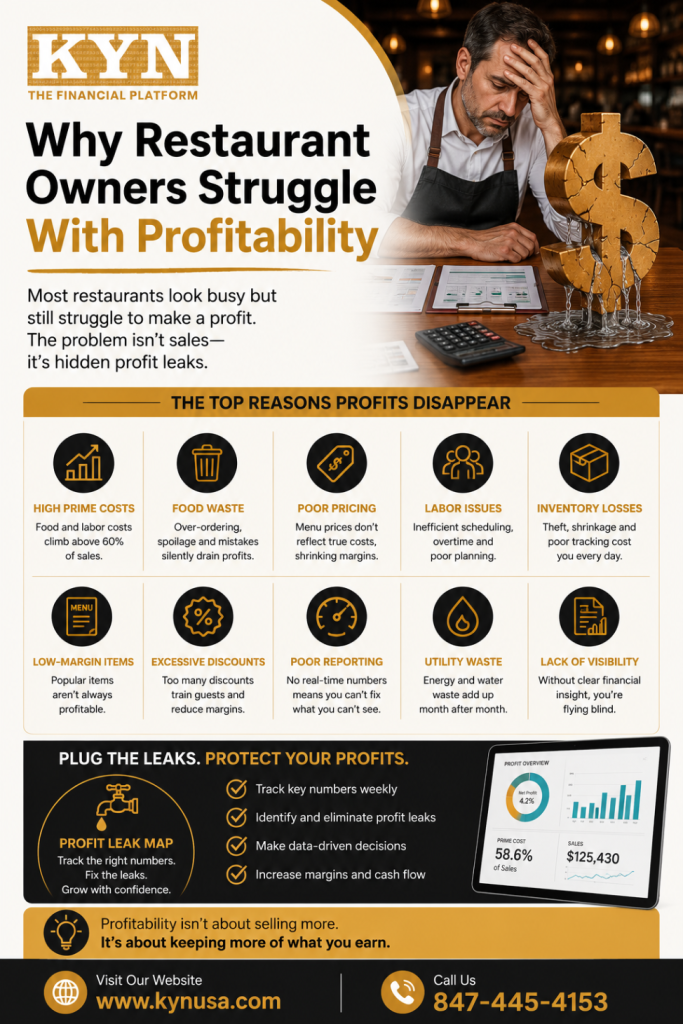
The Restaurant Profit Leak Map
At KYN | Know Your Numbers, we call this diagnostic the Profit Leak Map — a simple
framework for finding exactly where money escapes your restaurant. Think of your restaurant
like a bucket filled with revenue.
Sales continue flowing into the bucket every day, but several holes allow money to escape.
Common profit leaks include:
● Rising food costs
● High labor expenses
● Food waste
● Inventory shrinkage
● Poor menu pricing
● Low-margin menu items
● Slow inventory turnover
● Excessive discounts
● Utility waste
● Lack of financial reporting
The goal isn’t simply selling more food—it’s plugging these leaks before trying to fill the bucket
faster.
1. Prime Costs Are Too High
Prime cost combines your two largest operating expenses:
● Food Cost
● Labor Cost
Together, these typically account for 55–65% of restaurant sales. If prime costs rise beyond that
range, profitability quickly declines — most consistently profitable operators work to keep
prime cost at or below 60% of sales.
Warning Signs
● Payroll continues increasing
● Ingredient prices keep rising
● Profit decreases despite strong sales
● Overtime becomes common
● Scheduling feels inconsistent
Many owners focus only on revenue instead of watching prime costs weekly.
How to Fix It
● Monitor food and labor costs every week.
● Optimize employee scheduling.
● Cross-train team members.
● Review supplier pricing regularly.
● Negotiate vendor contracts.
2. Food Waste Is Quietly Destroying Margins
Food waste is one of the largest hidden restaurant profit leaks. Waste happens through:
● Over-ordering
● Spoilage
● Incorrect preparation
● Large portions
● Returned meals
● Kitchen mistakes
The scale is enormous: the USDA estimates that 30–40% of the U.S. food supply is wasted —
roughly $161 billion worth of food each year — and ReFED data shows the foodservice sector
accounts for about 20% of it. Every discarded ingredient represents money already spent.
Signs of Excessive Waste
● Frequent expired inventory
● Full trash bins after service
● High purchasing costs
● Inventory shortages
Ways to Reduce Waste
● Track waste daily.
● Standardize recipes.
● Improve inventory rotation.
● Train kitchen staff.
● Forecast demand more accurately.
Small improvements in waste management often create immediate profitability gains.
3. Menu Pricing Doesn't Reflect Actual Costs
Many restaurant owners price menu items based on competitors rather than actual profitability.
Unfortunately, ingredient prices change constantly.
If menu prices remain unchanged while food costs increase, margins shrink.
Common Pricing Mistakes
● Pricing emotionally
● Never reviewing menu costs
● Ignoring inflation
● Underpricing best-selling items
● Offering oversized portions
Better Pricing Strategy
Review menu engineering every quarter by analyzing:
● Ingredient cost
● Labor required
● Popularity
● Profit contribution
The highest-selling menu item isn’t always the most profitable.
4. Labor Scheduling Is Inefficient
Labor is usually the second-largest restaurant expense.
Poor scheduling creates unnecessary payroll costs.
Examples include:
● Too many employees during slow hours
● Overtime pay
● Excessive manager coverage
● Poor shift planning
Warning Signs
● Labor percentage fluctuates dramatically
● Employees spend time waiting for customers
● Frequent overtime
● High employee turnover
Improve Labor Efficiency
Use sales forecasting to build schedules based on expected customer demand instead of habit.
Better scheduling improves service while reducing unnecessary payroll.
5. Inventory Isn't Being Managed Properly
Inventory problems create invisible financial losses.
Without regular inventory counts, restaurants often experience:
● Theft
● Spoilage
● Over-purchasing
● Missing products
● Ordering duplicates
Inventory should never be treated as a monthly task.
Best Practices
● Conduct weekly inventory counts.
● Compare actual inventory with POS sales.
● Investigate unusual variances.
● Monitor high-value ingredients carefully.
Consistent inventory management protects both cash flow and profitability.
6. Restaurant Owners Don't Know Their Numbers
Many owners understand operations better than finances.
They know:
● Customer counts
● Online reviews
● Staff schedules
But they often don’t know:
● Weekly gross profit
● Prime cost percentage
● Food cost percentage
● Labor percentage
● Cash flow
● Net profit margin
Without visibility into these metrics, decisions become reactive instead of proactive.
Financial visibility is one of the strongest competitive advantages a restaurant can build.
This is the gap KYN | Know Your Numbers was built to close. Accounting software tells you what happened last month; a financial performance platform like KYN shows you what’s happening
right now — daily revenue, prime cost, and cash position, in one place.
7. Discounts Reduce More Profit Than Expected
Discounts can increase traffic but often reduce profitability.
Examples include:
● Frequent coupons
● Large promotional offers
● Excessive loyalty rewards
● Delivery platform discounts
Each discount reduces contribution margin.
Before launching promotions, calculate whether increased sales actually offset lower profit.
8. High Sales Don't Always Mean High Profit
Many restaurant owners assume higher sales automatically create more profit.
Unfortunately, that’s not always true.
Imagine two restaurants each generating $100,000 in monthly revenue.
Restaurant A controls costs carefully.
Restaurant B experiences:
● Food waste
● High labor
● Pricing issues
● Inventory losses
Both generate identical revenue.
Only one remains profitable.
Revenue measures activity.
Profit measures success.
9. Cash Flow Problems Hide Behind Good Sales
Cash flow and profitability aren’t identical.
A restaurant may report accounting profits while struggling to pay suppliers.
Cash flow issues often result from:
● Slow receivables
● Excess inventory
● Equipment financing
● Loan repayments
● Seasonal fluctuations
Healthy restaurants monitor cash flow weekly—not just monthly financial statements.
10. Financial Reports Are Reviewed Too Late
Many restaurants only review financial statements at month-end.
By then, thousands of dollars may already be lost.
Instead, track key performance indicators every week.
Important metrics include:
| KPI | Recommended Frequency |
|---|---|
| Food Cost % | Weekly |
| Labor Cost % | Weekly |
| Prime Cost | Weekly |
| Inventory | Weekly |
| Sales Mix | Weekly |
| Cash Flow | Weekly |
| Net Profit | Monthly |
Frequent reporting enables faster decision-making.
Practical Ways to Improve Restaurant Profitability
If you’re serious about how to improve restaurant profitability, focus on building better
financial habits rather than chasing higher sales alone.
Start by:
● Reviewing food costs weekly.
● Tracking labor percentages.
● Updating menu pricing quarterly.
● Counting inventory consistently.
● Monitoring waste.
● Measuring prime cost.
● Reviewing cash flow.
● Eliminating unnecessary expenses.
● Improving purchasing decisions.
● Using financial dashboards.
Small improvements across several areas usually produce larger gains than one major change.
Key Takeaways
● Restaurant profitability depends on controlling costs—not just increasing revenue.
● Prime cost should be monitored every week.
● Food waste quietly reduces profits.
● Menu pricing requires regular updates.
● Labor scheduling directly impacts margins.
● Inventory management prevents hidden losses.
● Financial visibility enables faster decisions.
● Small profit leaks compound over time.
● Weekly financial tracking improves long-term performance.
● The best-performing restaurants consistently monitor their numbers
FAQs
1 Why do restaurants struggle to make money?
2 What is the biggest profit leak in restaurants?
3 How often should restaurant owners review financial performance?
4 Can increasing sales alone improve profitability?
Download the Free Restaurant Profit Leak Checklist
Ready to find out where your restaurant is leaking profit? Download KYN's free Restaurant Profit Leak Checklist — a one-page audit covering all ten leaks in this guide, with the exact numbers to track each week. Visit kynusa.com to get your copy, or call us at 847-445-4153 to talk through your numbers with our team
Final Thoughts
Every restaurant experiences some degree of margin pressure. The difference between
struggling operators and consistently profitable businesses isn’t luck—it’s visibility.
Owners who understand their numbers can identify problems early, make informed decisions,
and protect their margins before small issues become major financial challenges.
If your goal is long-term success, don’t focus solely on increasing sales. Start by finding and
fixing your restaurant profit leaks. As you improve financial visibility, optimize prime costs,
reduce waste, and refine pricing strategies, you’ll build a restaurant that’s not only busy—but
sustainably profitable. And when you’re ready to see your numbers daily instead of waiting for
month-end reports, KYN is built for exactly that.