

insights
KYN Insights
Operator Playbooks · Mohan Patel
Cash Clarity for Multi-Location Operators
6
Series · Cash Clarity for Multi-Location Operators
Part 1 of 6
Cash Flow vs. Profit: Why Growing Operators Run Out of Money
Why profitable, growing operators run out of cash — and the weekly numbers that keep you solvent.

Mohan Patel
Founder, KYN
On this page
Not long ago a friend of mine called me, frustrated. He’s a good operator — he’s run restaurants for years. His P&L looked great: profitable month, healthy margins, the whole picture. But there was almost nothing left in the bank. “I don’t get it,” he said. “The numbers say I made money. So where is it?”
I knew exactly what he was feeling, because I’ve stood in that same spot myself.
A few years into running multiple locations, my accountant called on a Tuesday to tell me we’d had a profitable month. A good one, actually — one of the best of the year. The P&L looked healthy top to bottom. On paper we’d made real money, and I let myself feel it for a second: the hiring, the late nights, the second location finally pulling its weight. It was working.
Then I logged into the bank account to move some money around.
$122.
One hundred and twenty-two dollars. Not a hundred and twenty-two thousand — one hundred and twenty-two dollars, sitting under a month my own P&L had just called a win. Payroll was days away. I read the number three times, certain I’d opened the wrong account. My stomach dropped the way it does when you miss a stair in the dark.
I sat there with the statement in one hand and the bank screen in the other — two documents about the same business, the same month, telling me two completely different stories. And I thought the exact thing my friend said to me years later: the numbers say I made money, so where is it?
That question stuck with me. It also gave me a rule I’ve never broken since: I won’t run a business I can’t see weekly, in cash — not just monthly, in profit.
What 30 Years Taught Me
In more than 30 years — working with over 500 business owners and managing more than 170 restaurant locations across six states — I kept running into that same question. Where did the money go? It turns up in almost every small business somewhere along the way. The P&L says you made money, the bank account says otherwise, and by the time anyone can explain the gap, it has already done its damage.
Here’s what I came to understand: these owners weren’t bad at business. They were flying with the wrong instrument. They could see profit at the end of the month, but they couldn’t see the three things that actually decide whether a business survives — where the money really went, what this week’s profit is, and what the next 13 weeks of cash flow are about to do — while there was still time to act on any of it.
I call that missing space the decision gap: the point where owners get their numbers too late to change the outcome. Close that gap and almost everything else gets easier. This article — the first in a series — is about the most expensive version of it: cash.
Why Clean Books Come First
There’s a reason “garbage in, garbage out” has survived as a cliché: it’s ruthlessly true in finance. A beautiful dashboard doesn’t make numbers correct — it just makes wrong numbers look authoritative. And wrong numbers you trust are more dangerous than no numbers at all, because they move you to act with false confidence.
And it’s expensive. Gartner estimates poor data quality costs organizations an average of $12.9 million a year — and the damage usually isn’t missing data, it’s confident decisions made on inaccurate data.
Clean books mean three things: your accounts are reconciled to what actually happened in the bank, your transactions are categorized consistently, and the whole thing is current — not six weeks behind. When those three hold, a number you read is a fact. When they don’t, every downstream tool is guessing in a nicer font.
The Short Answer
THE SHORT ANSWER
Profit doesn’t pay your bills — cash does. Growing operators run out of money because expansion ties up cash in inventory, payroll, and buildout before the new revenue lands. The cash gap, not the P&L, is what sinks profitable restaurants. Track cash and profit together.
That’s the whole article in four sentences. But the why is what saves your business — so let’s go deeper.
Profit Is an Opinion. Cash Is a Fact.
Here’s the part nobody explains when you’re starting out.
Profit is an accounting opinion. Your P&L is built on rules: when revenue is “recognized,” how expenses get matched to periods, how depreciation spreads out, what gets accrued. All legitimate. None of it wrong. But it’s a representation of your business, shaped by assumptions and timing.
Cash is a fact. It’s the money in your account today, after every real dollar has moved. You can’t argue with it. You can’t accrue your way around it. It pays your team on Friday or it doesn’t.
The two numbers are supposed to tell the same story over time. But in the short run — especially while you’re growing — they can point in opposite directions. Your P&L can show a strong profit the same month your balance drops to $122.
“Profit is an opinion. Cash is a fact.”
When that happens, most owners assume something’s broken. Usually nothing is. The money just went somewhere the P&L doesn’t show you in real time.
The KYN Cash Flow Triangle™
Here’s the simplest way I’ve found to explain how the pieces fit together — a model I’ve taught for years and now call the KYN Cash Flow Triangle™.
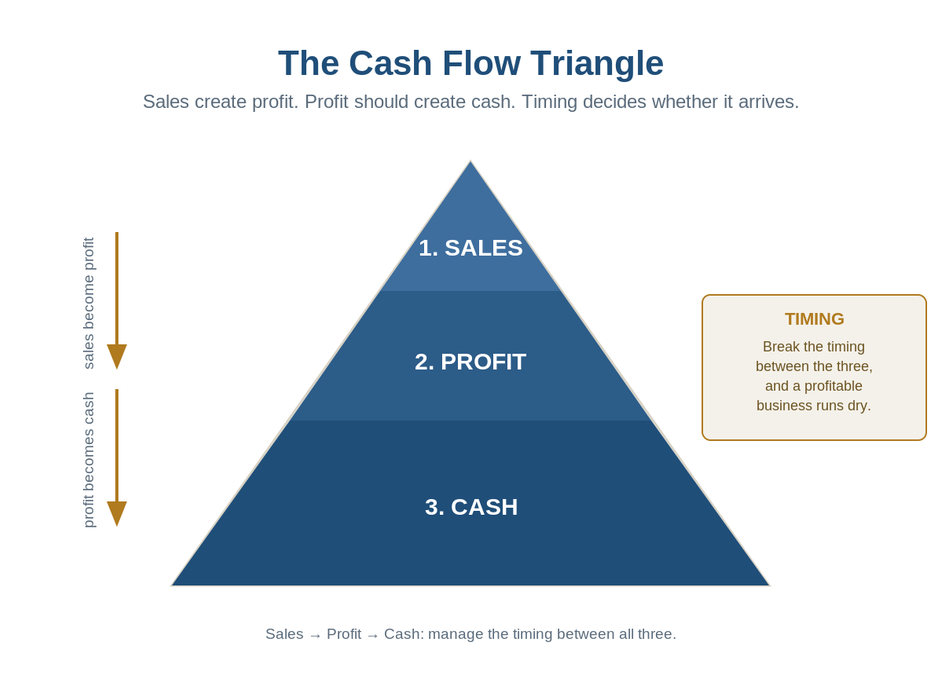
Sales create profit. Profit should create cash. Timing decides whether that cash arrives when you need it — break the timing, and a profitable business still runs dry.
Most owners watch the top of the triangle and assume the bottom takes care of itself. It won’t — not while you’re growing. The whole game is managing the timing between the three.
The Cash Gap: Why Growth Eats Cash
Let me describe the trap. It’s so common it’s almost a rite of passage.
You’ve got a good location. Sales are climbing. Margins look fine. So you do the natural thing — you grow. A second location, maybe. Or you push hard on volume at the one you have. Now watch where the cash actually goes:
- Inventory goes up before the sales arrive. More food, more supplies, more product — and you pay for it now.
- Payroll goes up before the new revenue stabilizes. You hire and train ahead of demand, and you cover those checks every two weeks regardless.
- Buildout, deposits, equipment, pre-opening costs — all of it hits before a single new customer walks in.
- Receivables stretch you. Money you’ve “earned” on paper hasn’t been collected and deposited yet.
Every one of those is an investment in growth. Every one is real cash leaving your account. And every one happens before the revenue that’s supposed to justify it shows up.
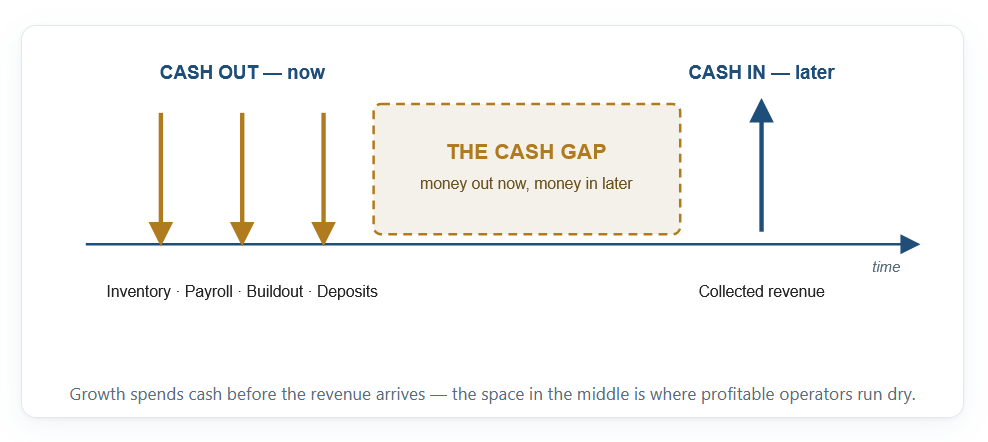
That space in between — money out now, money in later — is the cash gap. It’s invisible on a monthly P&L, because the P&L is busy telling you the growth was profitable. It was. That’s exactly what makes it dangerous. A profitable, growing business can run completely out of cash and never see a warning on the one report it’s watching.
What I’ve Seen in the Real World
I worked with an operator who had one strong, genuinely profitable location. On the back of a great year, he opened his third. The numbers said he’d earned it.
Four months later he was funding payroll off a personal credit card.
Nothing was failing. His P&Ls looked fine. The new location was ramping faster than expected. But the cash to carry three locations through their gaps — inventory, payroll, ramp-up — had quietly drained everything the profitable year produced. The profit was real. It was just locked up in the growth, and the bank account paid for it.
I’ve seen the opposite too. Another operator had flat sales and looked weaker on paper than his faster-growing competitors. But he ran his working capital tight — controlled inventory, collected quickly, never missed payroll. We’d helped him build that weekly cash discipline long before he needed it. When a downturn hit, he had the reserves to ride it out. Several of those “stronger” competitors didn’t. On paper he looked average. In cash, he was bulletproof.
We didn’t fix the first operator with a clever accounting move. We set up weekly cash reviews across all three locations and rebuilt his cash conversion cycle. In plain terms: we started watching cash weekly instead of waiting for month-end. Once he could see the gap forming in real time, he could slow down, stagger commitments, and protect payroll before the credit card came out. Same business. Same numbers. Completely different outcome — because the timing of the information changed. Weekly beat monthly. That was the whole difference.
After 500-plus owners and 170-plus locations, I can tell you these aren’t the exceptions. They’re the pattern. The operators who get hurt aren’t the careless ones. They’re often the successful ones, growing on profits they can’t actually touch yet.
The Numbers That Warn You Early
So how do you see the cash gap before it becomes a credit-card problem? You stop treating cash as something you check after the month closes, and you start managing a few numbers every week. This is cash flow management in practice:
1
Cash on hand & runway
Not just the balance — how many weeks of obligations it covers, and which way the trend is pointing.
2
The cash gap
Committed cash-out (inventory, payroll, fixed costs) versus what you can realistically collect in the same window.
3
Working capital (CCC)
How fast inventory turns, how quickly you collect, how you time payables: DIO + DSO − DPO.
4
Profit & cash, side by side
Read both together every week and “where did the money go?” stops being a mystery.
- Cash on hand — and your runway. Not just the balance, but how many weeks of obligations it covers. A number trending down three weeks running is a warning you can act on. A number you see once a month is a eulogy.
- The cash gap itself. What you’ve committed to (inventory, payroll, fixed costs coming due) versus what you can realistically collect in the same window. When commitments keep leading collections, you’re financing growth out of your own pocket.
- Working capital. The timing of money in and money out — how fast inventory turns, how quickly you collect, how you schedule what you owe. True control means optimizing your Cash Conversion Cycle (CCC): Days Inventory Outstanding (DIO), Days Sales Outstanding (DSO), and Days Payable Outstanding (DPO).
CCC = DIO + DSO − DPO
It’s one of the highest-leverage skills a multi-location operator can learn, because working capital directly controls how wide your cash gap gets. - Profit and cash, side by side. The single most important habit. The day you start reading both together is the day “where did the money go?” stops being a mystery.
None of these need an accounting degree. They need visibility — and the discipline to look while you still have time to change the outcome.
How to Close the Cash Gap
- Stagger your growth commitments. Don’t let inventory, hiring, and buildout all hit in the same cash window. Spread the cash-out so your account isn’t carrying every investment at once.
- Hold a reserve sized to your ramp. Before you expand, know how many months of negative cash a new location will run — and set that cash aside. Hope is not a working-capital strategy.
- Tighten the cycle. Turn inventory faster, collect faster, time your payables intelligently. Shrinking the days between money-out and money-in shrinks the gap directly.
- Review weekly, decide weekly. A monthly look tells you what happened. A weekly look lets you act. That difference is the whole game.
What I Finally Did About It
The honest part: you can’t manage cash you can’t see, and you can’t trust numbers that aren’t clean. After enough years of watching good operators get blindsided by something so predictable, I got tired of it — so I built the system I wished I’d had.
That’s the KYN Financial Platform. It starts from one hard rule: your numbers have to be clean and reconciled first, because any dashboard built on messy books is just fast garbage. From there it turns those numbers into a live picture of cash and profit across every location — where the money went, what this week’s profit is, and what the next 13 weeks of cash flow are about to do.
I didn’t offer it to anyone else until I trusted it myself. I’ve run my own business on it for the last five years — every week, in cash and in profit — before I ever put it in front of another operator. It earned its place in my own company first.
Clean data you can’t see doesn’t help you. A beautiful dashboard on messy books actively hurts you. You need both. That combination is what closes the decision gap — turning “where did the money go?” into “I know exactly where it’s going, and here’s what I’m doing about it.”
The KYN Decision Framework
Every article in this series comes back to the same five-step loop — the one I run my own business on:
THE KYN DECISION FRAMEWORK
- Know Your Books — start from clean, reconciled numbers. Nothing downstream works without this.
- Know Your Numbers — see cash and profit together, across every location.
- See the Trend — look weeks ahead, not just back at last month.
- Make the Decision — act while you still have room to change the outcome.
- Review Every Week — make it a standing habit, not a fire drill.
Key Takeaways
THE 5 THINGS TO REMEMBER
- Profit is an opinion; cash is a fact. In any single month they can point in opposite directions.
- Growth eats cash. Inventory, payroll, and buildout leave your account before the new revenue lands.
- The cash gap — not the P&L — is what sinks profitable, growing operators.
- Watch four numbers weekly: cash runway, the cash gap, working capital (CCC), and profit-and-cash side by side.
- Clean books plus live visibility means you make the decision while there’s still time to change the outcome.
Common Questions
1 What’s the difference between cash flow and profit?
2 Why is my profitable restaurant out of cash?
3 What is the cash gap?
4 How much working capital do I need before I grow?
Most owners look at numbers after the month ends. Winning owners look while they still have time to change the outcome. Right Numbers. Right Time. Right Decisions.
That $122 balance taught me the difference. I’d rather you learn it from this article than from your bank account.
Today, every decision I make begins with one question: what are the numbers telling me? That’s the philosophy behind KYN — Know Your Numbers — because better decisions start with better visibility.
Want to see your own cash and profit side by side, in real time, across every location? Book a KYN demo and I’ll walk you through it personally — we’ll find your cash gap together.
GET THE TOOL
Prefer something you can use this week? Download the free Cash Flow Health Checklist — a one-page PDF that walks you through the weekly numbers in this article so you can spot your cash gap before it opens up.
IF YOU REMEMBER ONE THING
Profit explains the past. Cash decides whether you survive next week. Read them together — weekly, not monthly.
Numbers don’t make decisions. Owners do. The right numbers simply help you make the right one.
Mohan Patel
Founder, KYN USA
Mohan Patel has spent more than 30 years in the trenches of multi-location operations. He founded KYN after watching too many profitable operators get blindsided by cash, and he still runs his own business on the platform every week — because better decisions start with better visibility.
KYN is the Financial Performance Platform for multi-location operators.
- 30+ years in restaurant operations
- Managed 170+ restaurant locations
- Helped 500+ business owners
- Founder of the KYN Financial Performance Platform
30+
years operating
500+
owners advised
170+
locations run
6
states