

Restaurant Prime Cost: Formula, Examples & Benchmarks
 Jul 12,2026
What Is Prime Cost and Why It Matters?
Running a successful restaurant isn’t just about serving delicious food or delivering excellent service. Behind every profitable restaurant is a deep understanding of its numbers — especially restaurant prime cost, the one metric that combines your two largest expenses into a single, decisive figure.
If you track only one financial number every week, make it this one. Prime cost combines your Cost of Goods Sold (COGS) and total labor costs — and together, those two categories decide whether your restaurant makes money or loses it. Whether you run a café, a quick-service concept, a fine-dining room, or a multi-location group, understanding prime cost can dramatically improve profitability.
At KYN | Know Your Numbers, we help restaurant owners see numbers like prime cost in real time — not
weeks later — so problems get fixed while they’re still small. In this guide, you’ll learn:
• What restaurant prime cost is
• The prime cost formula
• How to calculate prime cost, step by step
• A real-world worked example
• Ideal prime cost percentage benchmarks
• Common mistakes and proven ways to lower prime cost
• Where to download the free Prime Cost Calculator
What Is Restaurant Prime Cost?
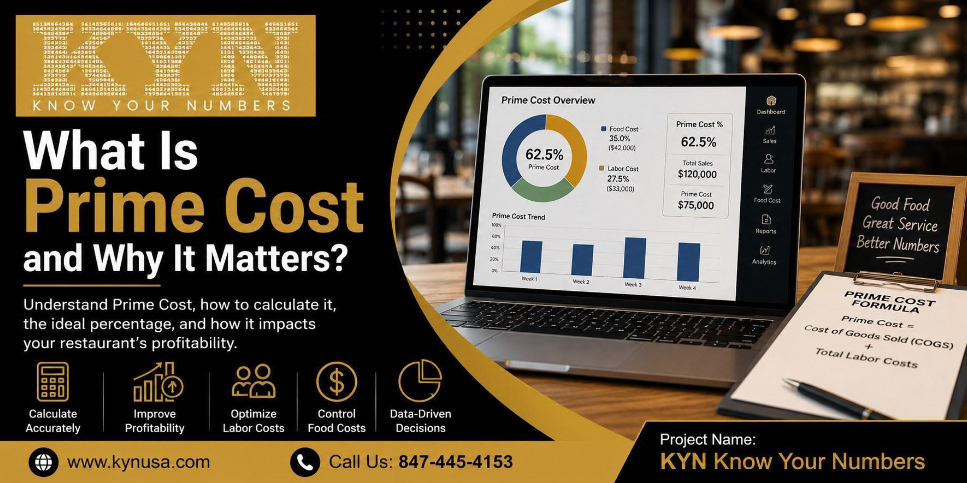
Restaurant prime cost is the sum of your Cost of Goods Sold (food and beverage) and total labor costs,
expressed as a percentage of sales. Most healthy restaurants keep prime cost between 55% and 65% of
total sales, making it the single most important measure of restaurant profitability.
It combines:
• Food cost
• Beverage cost
• Payroll (kitchen and front-of-house)
• Payroll taxes
• Employee benefits
• Overtime
Because these two categories typically consume 55 to 65 cents of every sales dollar, no other number has a
greater impact on your bottom line. Think of prime cost as the financial heartbeat of your restaurant: when it
rises, profit falls — even while sales are increasing
Why Prime Cost Matters
Many restaurant owners focus only on revenue, but revenue alone doesn’t determine success. Consider two restaurants with identical sales:
| Restaurant | Monthly Sales | Prime Cost | Profit |
|---|---|---|---|
|
Restaurant A |
$100,000 |
80% |
Very low |
|
Restaurant B |
$100,000 |
58% |
Much higher |
Both generate the same revenue, yet only one keeps enough money to cover rent, utilities, marketing,
equipment, taxes — and owner profit. That’s why prime cost is the single most important number in
restaurant finance.
The margin for error is thin. Industry benchmarks consistently put average restaurant net profit margins at just 3–5% of sales (see current benchmarks). At margins that tight, a two-point rise in prime cost can erase half your profit.
Prime Cost Formula
The prime cost formula is straightforward:
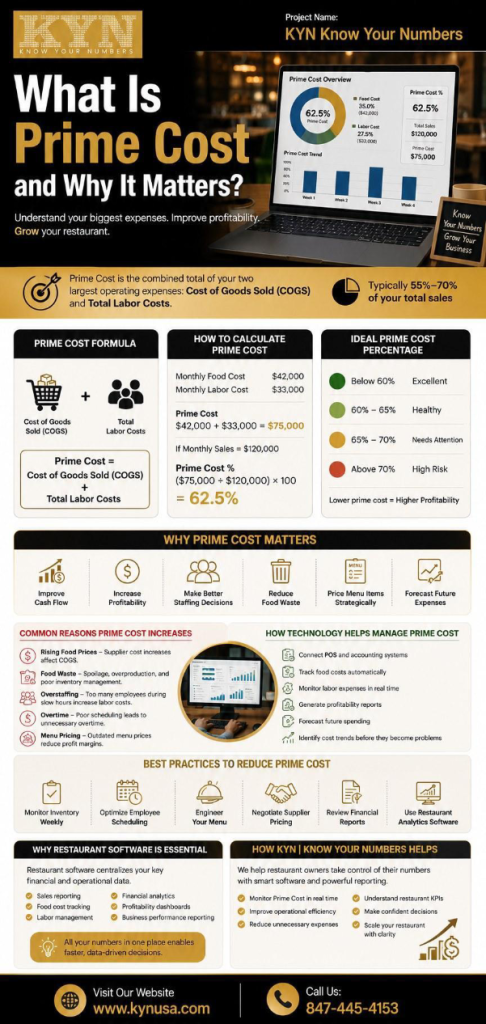
Prime Cost = Cost of Goods Sold (COGS) + Total Labor Costs
To express it as a percentage of sales:
Prime Cost % = (COGS + Total Labor Costs) ÷ Total Sales × 100
What counts as COGS?
COGS includes everything required to produce your menu items: meat, seafood, poultry, produce, dairy,
bread, beverage ingredients, alcohol, cooking oil, garnishes, and takeout packaging. COGS moves with your inventory — it rises and falls as purchasing, portioning, and waste change.
What counts as labor?
Labor includes every employee-related expense: kitchen and server wages, bartender wages, manager
salaries, payroll taxes, employee benefits, overtime, paid vacation, and bonuses. Don’t underestimate this
side of the equation — for many restaurants, labor is the single largest operating expense
How to Calculate Prime Cost
Let’s calculate a real example. Imagine your restaurant reports the following weekly numbers
| Metric | Amount |
|---|---|
|
Food & beverage cost (COGS) |
$18,000 |
|
Labor cost |
$22,000 |
|
Weekly sales |
$68,000 |
1. Add COGS and labor: $18,000 + $22,000 = $40,000
2. Divide by sales: $40,000 ÷ $68,000 = 0.588
3. Multiply by 100: 0.588 × 100 = 58.8%
Restaurant prime cost = 58.8% — comfortably within the recommended benchmark.
Prefer to skip the manual math? Download the free KYN Prime Cost Calculator — enter your weekly food,
labor, and sales numbers and get your percentage instantly.
What Is the Ideal Prime Cost Percentage?
One of the most common questions owners ask is: what is the ideal prime cost percentage? Here are the
general benchmarks:
| Prime Cost % | Meaning |
|---|---|
|
Under 55% |
Excellent |
|
55–60% |
Very healthy |
|
60–65% |
Acceptable |
|
65–70% |
Needs attention |
|
Above 70% |
High risk |
Every restaurant is different — quick-service concepts often achieve lower prime costs than fine-dining
establishments because of different labor models and menu structures. As a rule, staying between 55% and 65% of sales is considered healthy.
Why You Should Track Prime Cost Weekly
Many restaurants review financial reports once a month — and that’s often too late. Imagine discovering
four weeks after the fact that food waste increased, overtime doubled, vendor prices rose, portion sizes
crept up, or inventory walked out the back door. By then, thousands of dollars are already gone.
Weekly monitoring lets you detect labor problems early, spot inventory issues, adjust staffing faster, improve purchasing decisions, and protect your margins. Weekly tracking creates faster decisions — and faster decisions create healthier restaurants.
This is the philosophy KYN is built on: your accounting reports tell you what happened last month. KYN
shows you what’s happening right now, so you can act before the month is lost.
Common Reasons Prime Cost Increases
Several factors can quietly push prime cost higher:
• Rising food prices — supplier costs fluctuate through the year; without menu adjustments, margin
shrinks.
• Overstaffing — scheduling too many employees during slow periods quickly raises labor costs.
• Food waste — spoilage, overproduction, and poor inventory management inflate COGS.
• Oversized portions — even small increases in portion size compound across hundreds of meals.
• Employee overtime — frequent overtime is one of the fastest ways to blow past your labor budget.
• Poor inventory control — missing inventory usually signals waste, theft, or inaccurate ordering.
How to Reduce Restaurant Prime Cost
Improving prime cost doesn’t always require more sales — small operational improvements often produce
significant savings:
• Optimize employee scheduling. Schedule staff to sales forecasts rather than fixed shifts.
• Control portion sizes. Standardized recipes improve consistency while reducing waste.
• Review vendor pricing. Compare suppliers regularly and negotiate better pricing.
• Reduce food waste. Track spoilage and flag menu items with excessive waste.
• Improve inventory management. Weekly counts surface unusual losses before they compound.
• Increase high-margin sales. Promote menu items with the strongest profit margins.
• Train employees. Well-trained staff make fewer mistakes, waste less, and work more efficiently.
Prime Cost vs. Food Cost
Many owners confuse these two metrics — here’s the difference:
| Food Cost | Prime Cost |
|---|---|
|
Only food and beverage expenses |
Food + beverage + labor |
|
Measures ingredient spending |
Measures your biggest operating expenses |
|
Helpful for menu pricing |
Best single indicator of profitability |
Prime cost provides a much broader picture of your restaurant’s financial performance.
Mistakes Restaurant Owners Make
• Tracking only monthly numbers
• Ignoring labor costs and overtime
• Using estimated inventory values instead of real counts
• Not updating recipes or menu prices as costs change
• Never comparing against benchmarks
• Focusing on revenue instead of margin
Key Takeaways
• Prime cost = COGS + total labor costs
• Formula: (COGS + Labor) ÷ Sales × 100
• Most profitable restaurants maintain a 55–65% prime cost
• Track prime cost every week — not monthly
• Lowering prime cost improves profit without needing more sales
How KYN | Know Your Numbers Helps
At KYN | Know Your Numbers, we believe every restaurant owner should understand their numbers — not
just their sales. KYN is a financial performance platform that sits between your accounting and your
decisions, turning scattered, delayed data into daily intelligence.
Restaurant operators use KYN to monitor prime cost in real time, catch food-cost and labor drift early,
understand their KPIs, and make confident, data-driven decisions. Whether you run a single location or a growing multi-unit group, having accurate numbers in front of you every day changes how you operate.
Download the Free Prime Cost Calculator
Knowing your prime cost shouldn’t require a spreadsheet marathon. Our free Prime Cost Calculator lets you
enter your weekly food, beverage, labor, and sales figures — and instantly see your prime cost percentage
against industry benchmarks.
➜ Download the Prime Cost Calculator | Questions? Call us: 847-445-4153