

What Does Know Your Numbers Mean? | KYN for Restaurants
 Jul 09,2026
Why running a restaurant by the numbers separates operators who survive from those who scale
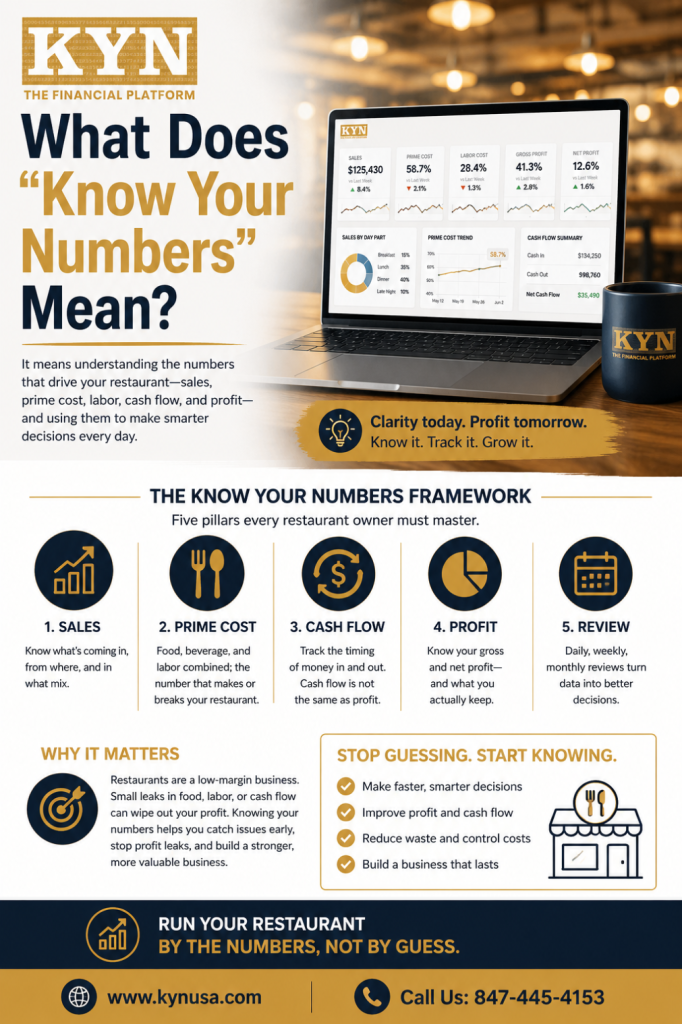
Knowing your numbers means understanding the figures that drive your business - sales, prime cost, labor, cash flow, and profit - and reviewing them often enough to act. For restaurants, it’s the shift from running on gut feel to running on real-time data, so problems get fixed before they cost you money.
Running a restaurant is about more than serving great food and delivering excellent hospitality. Ask
operators who have grown from one location to many what changed their trajectory, and you will hear a version of the same answer: they stopped managing by instinct and started running a restaurant by the numbers. They learned which figures actually drive the business, and they built the habit of reviewing those
figures often enough to act on them.
Many owners work tirelessly every day yet still can’t say where their profits are going. Sales are up, but the bank account is tight. Labor creeps. Food costs swing with every vendor invoice. Without clear, current
visibility into financial performance, every decision becomes a guess – and in an industry where the National
Restaurant Association puts typical pre-tax margins at just 3–5% of sales, guesses are expensive.
This is exactly the problem the Know Your Numbers philosophy -and the KYN brand -exists to solve.
The Know Your Numbers Framework
At KYN, we define knowing your numbers as a repeatable framework with five pillars. Master these in order and you move from reacting to your P&L to steering with it:
1. Know your Sales- what’s coming in, from where, and in what mix.
2. Know your Prime Cost – food, beverage, and labor combined; the number that makes or breaks a
restaurant.
3. Know your Cash Flow – the timing of money in and out, which is not the same as profit.
4. Know your Profit – gross and net, so you know what you actually keep.
5. Review on a cadence – daily flash numbers, weekly scorecards, monthly deep dives. Numbers you
don’t review on time are just history.
The framework is deliberately simple. The power isn’t in any single metric -it’s in reviewing all five, together, frequently enough that problems surface while they are still small and fixable

What Running a Restaurant by the Numbers Actually Looks Like
Picture two operators. The first finds out in the third week of the month that last month’s food cost ran three
points high – the information arrived with the accountant’s report, weeks after the waste, the portioning drift, or the vendor price increase actually happened. The money is already gone.
The second operator sees yesterday’s sales, labor, and food purchases on a dashboard every morning. When Tuesday’s labor runs hot, she adjusts Thursday’s schedule. When a supplier raises chicken prices, she sees it in the week’s prime cost -not in next month’s P&L. Same industry, same challenges; entirely different outcomes.
That’s the real difference between traditional bookkeeping and running a restaurant by the numbers.
Accounting looks backward; it tells you what happened. Performance management looks at now. As we put
it at KYN: not accounting – performance. The gap between those two is where most restaurant profit quietly
disappears.
The Numbers Every Restaurant Operator Should Track
1. Sales - the starting point, not the scoreboard
Everything begins with the top line: total sales, but also sales per day-part, per channel (dine-in, takeout, delivery), average check, and cover counts. Sales tell you about demand - but on their own they tell you almost nothing about health. A restaurant doing $100,000 a month can easily make less money than one doing $75,000 with tighter costs. For a deeper look at reading your top line, see our guide to restaurant sales metrics that actually matter.
2. Prime Cost -the single most important number
Prime cost combines your two largest expenses: cost of goods sold (food and beverage) plus total labor. Together they typically consume the majority of every sales dollar, and the widely used industry benchmark is to keep prime cost at or under 60% of sales. Because it captures both purchasing and staffing in one figure, prime cost is the fastest single read on whether your restaurant is fundamentally healthy. We break down the calculation, benchmarks, and weekly tracking in what is prime cost and why 60% is the line.
3. Food Cost Percentage
Food cost ÷ food sales × 100. A rising percentage is an early-warning light for waste, portioning drift, vendor price increases, theft, or inventory errors. The key is catching the move in days, not discovering it at month-end. Full walkthrough: how to calculate and control food cost percentage.
4. Labor Cost Percentage
Total labor ÷ sales × 100. Labor is usually the largest controllable expense in a restaurant, and it’s won or lost in scheduling - matching staffing to forecasted sales rather than to habit. See labor cost benchmarks and smarter scheduling.
5. Gross and Net Profit
Gross profit (revenue minus cost of goods sold) tells you whether menu pricing and purchasing hold up. Net profit - what remains after every expense - is the ultimate scoreboard, and it’s the number sales growth is supposed to serve. Higher sales do not automatically mean higher profit. More in reading your restaurant P&L like an operator.
6. Cash Flow
A restaurant can be profitable on paper and still miss payroll. Cash flow tracks the actual timing of money in and out - rent due on the 1st, payroll every other Friday, vendor terms, seasonal dips. Monitoring it weekly ensures bills are paid, payroll is never in doubt, and growth can be funded. Our guide: restaurant cash flow, explained simply.
Why Restaurant Financial Fluency Matters
Most restaurant owners are experts in hospitality who never received formal financial training. Restaurant
financial fluency is the ability to understand, interpret, and act on financial information – to look at a
scorecard and know what to do next. Financially fluent operators identify profit leaks quickly, control food
and labor costs, manage cash proactively, set realistic growth goals, and avoid costly surprises.
This is the know your numbers restaurant mindset in practice: experience still matters, but it gets paired with
data. Instead of reacting to problems after they show up in the bank balance, fluent operators see them
forming and act early. It’s the difference between owners who survive and operators who scale – and it’s askill, which means it can be learned.
Common Mistakes Restaurant Owners Make
• Focusing only on revenue. Sales tell part of the story; expenses decide the ending.
• Reviewing financials too late. Month-end or tax-season reviews leave no room to adjust. Successful
operators review key metrics weekly, and flash numbers daily.
• Using generic reporting. Standard accounting reports weren’t built for restaurants; operators need
restaurant-specific KPIs like prime cost front and center.
• Deciding on gut feel alone. Experience is valuable – but paired with real-time data, it’s decisive
The Benefits of Financial Clarity for Restaurant Owners
Financial clarity for restaurant owners pays off in every direction at once: better decisions, because they’re based on accurate and current data; improved profitability, because cost problems get caught while they’re small; stronger cash flow, because obligations are planned instead of survived; sustainable growth, because expansion decisions rest on measurable unit economics; and less stress, because you always know exactly where the business stands. Clarity turns the P&L from a monthly verdict into a daily tool.
How KYN Helps Operators Know Their Numbers
KYN was built by operators who have managed 170+ restaurant locations – not by accountants. The platform sits on top of your existing accounting and POS systems and turns that data into real-time performance visibility: daily dashboards, prime cost tracked against targets, location-by-location profitability, and cash flow you can actually see coming.
Whether you run one restaurant or twenty, the goal is the same: replace month-old reports with numbers
current enough to act on. We don’t just hand you reports – we help you understand what they mean and what to do about them
FAQs
1 What does “know your numbers” mean for a restaurant?
2 Which number should a restaurant owner track first?
3 How often should I review my restaurant’s numbers?
4 What’s the difference between profit and cash flow?
5 Do I need to replace my accountant to run my restaurant by the numbers?
Final Thoughts
Knowing your numbers is not an accounting exercise -it’s a competitive advantage. Operators who
understand their financial metrics make smarter decisions, protect their margins, and expand with
confidence. Financial clarity creates operational confidence: when you know exactly where your business
stands today, you can spend your energy on growth instead of uncertainty.