

Where Did The Money Go? Understanding Restaurant Cash Flow
 Aug 27,2026
Where Did The Money Go? Understanding Restaurant Cash Flow
"My accountant says we made money last month... so why is there barely anything in the bank?"
If you have ever asked that question, you are not alone. It is the single most common frustration
restaurant owners bring to their bookkeepers, and it comes from one of the most misunderstood ideas
in the industry: profit and cash are not the same thing.
A restaurant can report a healthy profit while struggling to cover suppliers, payroll, rent, or taxes. It can
also sit on plenty of cash for a short stretch while quietly losing money. Understanding restaurant cash
flow — the actual movement of money in and out of your business — is what separates operators who
are always surprised by their bank balance from operators who see problems coming weeks in advance.
The stakes are real. According to a widely cited U.S. Bank study, 82% of business failures are tied to
poor cash flow management. And restaurants have less room for error than almost anyone: research
from the JPMorgan Chase Institute, which analyzed the accounts of 600,000 small businesses, found
that restaurants hold a median of just 16 cash buffer days — the smallest cash cushion of any industry
studied.
In this guide, we will explain cash flow in plain language, show exactly why profitable restaurants run
out of cash, walk through a worked example where every dollar reconciles, and give you a practical
system — we call it Cash Flow Clarity — for always knowing where your money went.
What Is Restaurant Cash Flow?
Restaurant cash flow is the movement of money into and out of your restaurant over a period of time.
It tracks the actual dollars received and spent — regardless of what your Profit & Loss statement says
you earned.
Money comes in through food sales, beverage sales, catering revenue, delivery orders, gift card
redemptions, and other income. Money goes out through payroll, food purchases, rent, utilities, loan
payments, equipment purchases, taxes, marketing, and insurance.
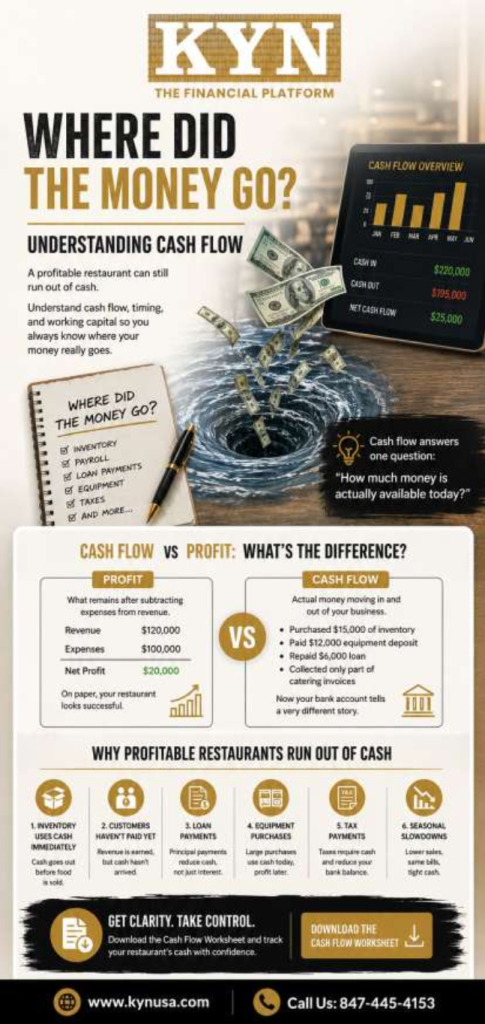
Cash flow answers one question: “How much money is actually available today?”
Unlike profit, which follows accounting rules, cash flow measures real dollars entering and leaving your
bank account. That distinction sounds small. It is the difference between a restaurant that survives and
one that does not.

Cash Flow vs Profit: What's the Difference?
This is where many restaurant owners get stuck, so let’s make cash flow vs profit concrete with one
month in the life of a typical restaurant.
Profit: What the P&L Says
Profit is what remains after subtracting expenses from revenue, according to accounting rules.
|
Revenue |
$120,000 |
|
Expenses |
$100,000 |
|
Net Profit |
$20,000 |
On paper, this restaurant looks successful — and with typical full-service restaurants keeping only 3–5
cents of profit from every dollar of sales, a $20,000 profit month is a good month.
Cash Flow: What the Bank Account Says
Now look at what actually happened to the money during that same month. The restaurant:
• Purchased $15,000 of inventory
• Paid a $12,000 equipment deposit
• Repaid a $6,000 loan installment
• Collected only part of its catering invoices
None of those events changed the month’s profit much — but every one of them drained the bank
account. That is why cash flow vs profit is one of the most important concepts every restaurant
operator must understand: profit is an opinion shaped by accounting rules; cash is a fact.
Why Profitable Restaurants Run Out of Cash
Many owners ask: “If we’re profitable, why can’t we pay our bills?” The answer almost always comes
down to timing — cash leaves before revenue arrives, or leaves through doors the P&L never shows.
Here are the six biggest reasons why profitable restaurants run out of cash.
1. Inventory Uses Cash Immediately
When you purchase inventory, cash leaves your account the moment you pay the supplier — but the
food may not be sold for days or even weeks. Until customers buy those meals, your money is sitting on
shelves and in walk-in refrigerators. Large inventory purchases reduce cash without immediately
affecting profit.
2. Customers Haven’t Paid Yet
Restaurants that offer catering, corporate accounts, or private events often invoice on 30-day terms.
The revenue appears on your income statement the day of the event — but the cash may not reach your
bank for a month or more. You earned the money. You just haven’t received it yet.
3. Loan Payments Take More Cash Than the P&L Shows
Loan principal is not considered an expense on your Profit & Loss statement — only the interest is. But
every loan payment removes the full amount from your bank account. For example:
| Monthly loan payment | $3,000 |
|---|---|
|
Interest (appears on the P&L) |
$500 |
|
Principal (invisible to the P&L) |
$2,500 |
Only the $500 of interest reduces profit. The full $3,000 reduces cash — every single month.
4. Equipment Purchases Hit Cash Today, Profit Slowly
Buying ovens, refrigerators, POS systems, or furniture requires cash immediately, but accounting
spreads that expense over several years through depreciation. Cash disappears today; profit changes
slowly. A $12,000 oven might reduce this month’s profit by only a few hundred dollars — while reducing
this month’s cash by the full $12,000.
5. Tax Payments Arrive in Lumps
Sales tax, payroll tax, income tax, and property tax all require cash — and several of them are paid in
large periodic lumps for money you earned months earlier. Some tax payments do not appear as current
operating expenses at all, but they absolutely reduce your bank balance when they come due.
6. Seasonal Slowdowns
Winter slow seasons, summer vacations, and holiday fluctuations mean revenue declines while fixed
costs — rent, salaried labor, insurance, loan payments — continue unchanged. With only 16 median
cash buffer days in the bank, a slow six weeks can turn a profitable restaurant into a late-on-payroll
restaurant. Without proper planning, cash shortages develop quickly.
Understanding Restaurant Working Capital
Another concept every operator should know is restaurant working capital — your ability to cover
short-term obligations with short-term resources. The formula is simple:
Working Capital = Current Assets − Current Liabilities
| Current Assets (what you can turn into cash soon) | Current Liabilities (what you owe soon) |
|---|---|
|
Cash in the bank |
Supplier invoices (accounts payable) |
|
Inventory |
Payroll owed |
|
Accounts receivable (unpaid invoices) |
Taxes due, credit card balances, short-term loans |
Positive working capital gives your restaurant flexibility — you can absorb a slow week, a broken freezer, or a late-paying catering client. Negative working capital means every bill becomes a negotiation, and financial stress compounds week after week.
The Three Sections of a Cash Flow Statement (in Plain Language)
Let’s put it all together with a month where every dollar reconciles. Imagine your restaurant posts these
results:
|
Monthly sales |
$200,000 |
|
Net profit (on the P&L) |
$18,000 |
|
Actual increase in the bank account |
$2,000 |
An $18,000 profit, but only $2,000 more in the bank. Where did the other $16,000 go? The cash flow
statement answers it line by line:
| Where the money went | Cash impact |
|---|---|
|
Net profit (starting point) |
+ $18,000 |
|
Add back depreciation (an accounting expense, not a cash
payment) |
+ $10,000 |
|
Cash generated before other uses |
$28,000 |
|
Inventory build-up (food bought but not yet sold) |
− $8,000 |
|
Equipment purchase (only depreciation touches the P&L) |
− $6,000 |
|
Loan principal repayment (never appears on the P&L) |
− $4,000 |
|
Tax payment for a prior quarter (earned then, paid now) |
− $3,000 |
|
Increase in accounts receivable (catering invoiced, not yet
collected) |
− $5,000 |
|
Net change in cash |
+ $2,000 |
$18,000 + $10,000 − $26,000 = $2,000. Nothing was stolen and nothing is broken — the restaurant
earned a real profit, but $26,000 of cash went to inventory, equipment, debt, taxes, and customers who haven’t paid yet. Now the numbers make sense. This is what it means to know where the money went.
Warning Signs of Poor Restaurant Cash Flow
Cash flow problems rarely arrive without notice. Watch for these signals:
• Payroll feels stressful every cycle
• Paying vendors late, or supplier relationships becoming strained
• Constantly leaning on credit cards
• Borrowing to cover routine operating expenses
• Low bank balances despite profitable months
• Delayed tax payments
These issues usually appear long before profitability becomes a problem. Catching them early is the
entire point of tracking cash flow.
Cash Flow Clarity: How to Improve Restaurant Cash Flow
Cash Flow Clarity is the operating discipline of knowing where every dollar is going before it leaves your
account — instead of discovering it at month-end. It is not complicated accounting; it is a weekly habit
built on six practices.
Forecast Weekly
Don’t wait until month-end. Every week, project expected sales, payroll, vendor payments, rent, taxes,
and loan payments for the weeks ahead. Weekly forecasts turn surprises into plans.
Reduce Excess Inventory
Too much inventory ties up cash on your shelves. Monitor food waste, overstock, slow-moving items,
and purchasing frequency. Smarter inventory management frees cash immediately — it is usually the
fastest cash flow win available to a restaurant.
Speed Up Customer Payments
If you invoice catering or corporate clients: send invoices immediately, offer online payment options,
follow up consistently, and reduce payment delays wherever possible. Faster collections shrink the gap
between earning money and having it.
Negotiate Vendor Terms
Instead of paying suppliers on delivery, negotiate Net 15, Net 30, or Net 45 terms. Longer payment
terms improve working capital without increasing sales by a single dollar.
Watch Prime Cost
Prime cost — labor plus cost of goods sold — is usually your largest cash expense and the single clearest
indicator of a restaurant’s financial health. Managing prime cost effectively improves both profitability
and cash flow at the same time.
Build a Cash Reserve
Every restaurant should maintain an emergency reserve, because even profitable restaurants face
equipment failures, seasonal declines, utility increases, and surprise repairs. Given that the median
restaurant holds just 16 days of cash buffer, working toward 30 or more days of operating expenses in
reserve puts you ahead of most of the industry.
Metrics Every Restaurant Should Track
Successful operators monitor more than revenue. Track these regularly:
• Daily cash balance and weekly cash flow
• Operating cash flow
• Prime cost (food cost % + labor cost %)
• Inventory turnover
• Accounts payable and accounts receivable
• Working capital
These numbers reveal problems while they are still small — before they become emergencies.
Common Cash Flow Mistakes to Avoid
• Looking only at the Profit & Loss statement
• Ignoring cash forecasts
• Buying too much inventory
• Expanding too quickly
• Delaying financial reporting
• Mixing personal and business finances
• Not reviewing cash flow weekly
How Technology Makes Cash Flow Clarity Easier
Modern restaurant financial platforms combine data from POS systems, accounting software, payroll,
banking, and inventory systems — so instead of waiting until month-end, operators get near real-time
visibility into cash movement.
That is exactly why we built KYN — Know Your Numbers. Created by operators who have managed 170+
locations (not just software developers), KYN turns daily operating data into answers to the questions
that matter: Where did the money go? Which location is consuming cash? Is labor eating my available
cash? Are inventory purchases too high? Will upcoming bills create a shortage?
Having this visibility lets restaurant owners make proactive decisions instead of reacting after cash gets
tight. Know your numbers, and you can grow with confidence.
Final Thoughts
Many restaurant owners focus entirely on sales and profit, assuming those numbers tell the whole story.
In reality, restaurant cash flow is what keeps the business operating day to day.
Understanding cash flow vs profit, monitoring restaurant working capital, and reviewing your cash flow
statement weekly prevents financial surprises — even during profitable periods. Remember:
Profit measures performance. Cash measures survival.
The restaurants that consistently succeed don’t just earn profits — they build Cash Flow Clarity, knowing
exactly where every dollar goes and making sure enough cash is available to support operations, growth,
and the unexpected.
GET CLARITY. TAKE CONTROL.
Download the Free Restaurant Cash Flow Worksheet and track your restaurant’s cash with confidence