


What Changes When You Go From 1 to 10 Restaurant Locations?
 Aug 01,2026
Growing from one restaurant to ten isn’t just expansion — it’s a complete transformation of how your
business operates.
Many restaurant owners believe adding locations simply means multiplying what already works. In
reality, going from 1 to 10 restaurant locations changes every aspect of your business. The systems that
helped you succeed with one store often become your biggest obstacles when managing ten.
We’re not writing this from theory. Before building KYN, our team operated and oversaw 90+ Papa
John’s locations. We’ve lived through the new-store openings, the surprise labor overruns, the monthend scrambles, and the slow realization that what got us to store three would never get us to store ten.
At one location, you can personally solve problems. You know your employees, watch food quality,
monitor inventory, and notice when labor costs creep too high.
At ten locations?
You no longer manage restaurants — you manage managers, systems, reports, and accountability.
Here’s what actually changes — and what we wish we had known sooner.
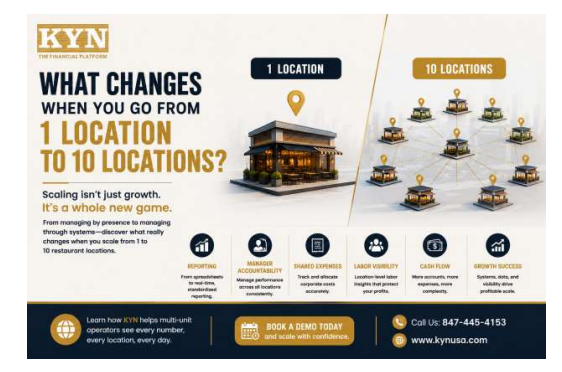
The Biggest Shift: You Stop Managing Stores and Start Managing Systems
When you own one restaurant, your presence solves many problems.
You notice:
• Food waste
• Employee performance
• Customer complaints
• Equipment issues
• Inventory shortages
Your eyes become the management system.
As you begin scaling a restaurant business, that approach simply stops working. You cannot physically
visit every location every day — and the day you try is the day something breaks at the store you didn’t
visit.
In our own stores, we learned this the hard way: problems we would have spotted in an afternoon at
one location sat undetected for weeks at stores we rarely walked into. Nothing was wrong with the
managers — the owner’s eyes simply weren’t there anymore, and nothing had replaced them yet.
Instead, decisions must come from standardized reporting and measurable KPIs. The question changes
from:
“What’s happening today?”
to
“Which location needs my attention first?”
That requires visibility into every restaurant’s numbers — consistently, and in something close to real
time.
Manager Accountability Becomes Everything
With one restaurant, owner involvement hides operational weaknesses.
With ten locations, weak management becomes expensive — fast.
Every store manager now becomes responsible for:
• Food cost
• Labor percentage
• Sales growth
• Customer satisfaction
• Waste control
• Inventory accuracy
• Profitability
The challenge isn’t hiring managers.
The challenge is holding every manager accountable to the same performance standards.
Across the Papa John’s stores we operated, the single most reliable predictor of a location’s profitability
wasn’t the neighborhood, the sales volume, or the age of the store. It was whether the manager saw
their own numbers every week and knew exactly which ones they owned.
Without consistent reporting, each location begins operating differently. That inconsistency quickly
impacts profits.
Reporting Can No Longer Live Inside Spreadsheets
A single restaurant can survive on spreadsheets. Ten restaurants cannot.
Imagine collecting every week:
• Sales reports
• Labor reports
• Food cost reports
• Inventory reports
• Payroll
• Vendor invoices
• Cash deposits
Across ten locations, that’s hundreds of files every month. Now imagine trying to compare them
manually — different formats, different naming, different definitions of “food cost” depending on who
built the sheet.
Instead, successful multi-unit restaurant management depends on centralized reporting where every
location follows identical KPIs.
You need to answer questions instantly:
• Which store has the highest labor?
• Which location has declining sales?
• Which manager consistently beats targets?
• Which restaurant is hurting company profit?
Without centralized reporting, finding answers takes hours instead of minutes. We spent years
assembling weekly review packets by hand before we accepted a hard truth: the reporting process itself
had become a full-time job that produced numbers already a week old.
Labor Stops Being "One Number"
One of the biggest surprises during expansion is labor visibility.
With one location, labor feels manageable. With ten, labor becomes one of your largest controllable
expenses — and averages start lying to you.
Consider this example:
| Location | Labor % |
|---|---|
|
Store A |
24%
|
|
Store B |
27%
|
|
Store C |
31% |
|
Store D |
36% |
At first glance, overall labor might appear acceptable. But one poorly managed location can erase the
profits generated by three strong locations.
We saw this pattern repeatedly in our own group: a store running 35%+ labor while its sister stores ran
24–27%, invisible for an entire quarter because the company-wide average looked fine.
Location-level labor reporting becomes essential. Instead of asking,
“How is labor?”
you ask,
“Which store has a labor problem?”
That level of visibility changes decision-making
Shared Expenses Become Harder to Track
Multi-unit businesses introduce costs that single restaurants rarely consider. Examples include:
• Corporate payroll
• Area managers
• Marketing
• Insurance
• Software subscriptions
• Delivery technology
• Administrative staff
These expenses affect every location. But how should they be allocated?
Without proper allocation, profitable stores may appear less profitable while weaker locations look
healthier than they really are. We’ve watched operators nearly close their best-performing store
because corporate overhead was being dumped onto it — and keep a genuinely unprofitable one
because its P&L carried none.
Accurate expense allocation creates a realistic picture of performance across all stores.
Cash Flow Gets More Complicated
Revenue grows. Expenses grow faster. Cash becomes harder to predict.
Many growing operators discover that increasing sales doesn’t automatically improve cash flow. Why?
Because expansion introduces:
• New equipment purchases
• Additional payroll
• Store openings
• Inventory investments
• Rent deposits
• Training expenses
• Marketing costs
Managing multiple bank accounts across several restaurants also increases financial complexity. Daily
sales alone no longer tell the complete story.
Owners need weekly visibility into:
• Cash balances
• Outstanding invoices
• Payroll obligations
• Upcoming expenses
• Vendor payments
Healthy sales without healthy cash flow create unnecessary financial stress. Some of our tightest weeks
as operators came in months with record sales — because two store openings, a payroll run, and a large
vendor payment all landed in the same ten days.
Standard Operating Procedures Become Non-Negotiable
One restaurant allows flexibility. Ten restaurants require consistency.
Successfully managing multiple restaurant locations depends on documented systems covering:
• Opening procedures
• Closing checklists
• Food preparation
• Inventory counting
• Labor scheduling
• Ordering processes
• Financial reporting
Without standardization, every manager creates their own version of success. That inconsistency
produces different customer experiences and unpredictable financial results.
Consistency scales. Improvisation doesn’t.
Every Location Needs Its Own Scorecard
One mistake growing operators often make is reviewing company-wide numbers only. Company
averages hide problems.
Imagine this situation:
| Location | Sales Growth | Prime Cost | Net Margin |
|---|---|---|---|
|
Store A |
+12% |
56% |
18% |
|
Store B |
+8% |
+58% |
+15% |
|
Store C |
-2% |
67% |
5% |
|
Store D |
+10% |
57% |
17% |
Overall company performance looks healthy. But Store C requires immediate attention.
Without location-level scorecards, struggling restaurants remain hidden until profits decline
significantly. Every manager should receive a consistent weekly performance report — the same format,
the same KPIs, every single week
Data Replaces Gut Feeling
At one location, intuition works surprisingly well. By ten locations, intuition becomes risky.
Successful operators rely on measurable KPIs such as:
• Daily sales
• Prime cost
• Food cost %
• Labor %
• Gross profit
• Net profit
• Average ticket size
• Inventory variance
• Cash flow
• Weekly trends
Numbers create objective decisions. Opinions create inconsistency.
Technology Becomes a Competitive Advantage
Growing businesses eventually reach a point where manual reporting slows expansion.
Instead of collecting numbers from multiple systems, leading operators automate financial visibility.
Modern restaurant reporting platforms can connect:
• POS systems
• Accounting software
• Payroll
• Banking
• Inventory
• Financial reporting
Instead of waiting until month-end, operators receive weekly — or even daily — performance insights.
That speed allows problems to be solved before they become expensive.
The Owner's Role Completely Changes
Perhaps the biggest transformation isn’t operational. It’s personal.
With one restaurant, you’re often:
• Working the floor
• Solving customer issues
• Helping in the kitchen
• Covering employee shifts
With ten restaurants, your focus shifts toward:
• Strategy
• Leadership
• Financial analysis
• Manager development
• Expansion planning
• Capital allocation
• Performance reviews
You become the leader of a business rather than the manager of a single restaurant. That transition
requires better information — not more hours.
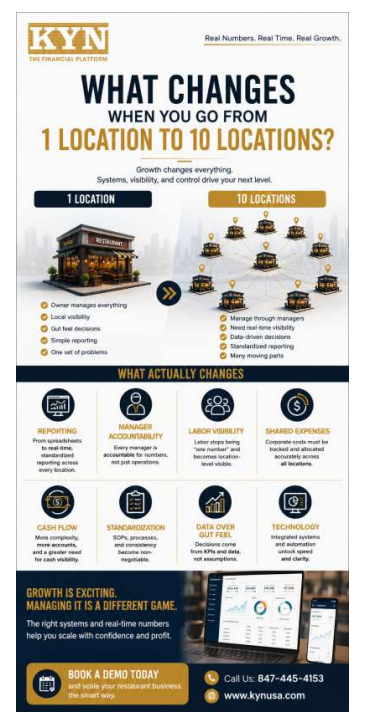
Why We Built KYN
Everything in this article is the reason KYN exists.
After years of running multi-unit P&Ls through spreadsheets, late-night report assembly, and month-old
numbers, we built the platform we always needed as operators. KYN — The Financial Platform connects
your POS, payroll, accounting, and banking into one real-time dashboard, so you can see every number,
at every location, every day.
No waiting for month-end. No guessing which store has a labor problem. No averages hiding your
weakest location.
Know Your Numbers. Grow With Confidence.
Final Thoughts
The journey of going from 1 to 10 restaurant locations is one of the most rewarding milestones in
restaurant ownership — and one of the most challenging.
Growth doesn’t simply multiply revenue. It multiplies complexity.
Success depends on replacing owner dependence with standardized systems, consistent reporting,
manager accountability, and real-time financial visibility.
Operators who embrace these changes build businesses that keep growing. Those who resist them often
discover that expansion creates more chaos than profit.
The difference isn’t working harder. It’s knowing your numbers — at every location, every week.
FAQs
1 How does managing 10 restaurant locations differ from managing one?
2 Why is centralized reporting important for multi-unit restaurant management?
3 What metrics should multi-location restaurant owners track?
4 What is the biggest challenge when scaling a restaurant business?
5 How can technology help manage multiple restaurant locations?
6 At what point does a restaurant group need centralized financial reporting?
Ready to Scale with Confidence?
If you’re growing past your first location — or already juggling several — see how KYN gives multi-unit
operators every number, at every location, every day.
Call us: 847-445-4153
Visit: www.kynusa.com