


Multi-Unit Business Financial Control as You Scale | KYN USA
 Aug 07,2026
How Multi-Unit Businesses Keep Financial Control as They Scale
A plain-English guide to multi-unit business financial control — one chart of accounts, one reporting
cadence, one consolidated view of every location.
Growing from one location to several is exciting — but it is also the moment financial complexity
multiplies. What worked for a single office, store, clinic, or restaurant quickly breaks down when
multiple teams, systems, and revenue streams enter the picture. The businesses that scale successfully
build multi-unit business financial control: standardized financial processes across every location,
rolled up into a single source of truth.
At KYN (kynusa.com), we learned these lessons the hard way. Our team built the KYN platform after
operating more than 170 restaurant locations — an industry where margins are thin and a two-week
reporting delay can erase a month of profit. The control principles that kept those restaurants
profitable are the same ones that work for retail chains, healthcare clinics, construction branches,
automotive groups, fitness centers, and professional service firms.
This guide explains how successful multi-unit organizations stay financially organized while they grow —
and ends with a free checklist you can put to work this week.

Why Does Financial Control Get Harder as a Business Scales?
A single location is relatively easy to monitor. The owner sees daily sales, expenses, payroll, inventory,
cash flow, and monthly profit — often from one system and one bank account.
Every additional location multiplies that complexity. Instead of one business, you are suddenly
managing multiple managers, different payroll schedules, separate vendor relationships, different
inventory levels, regional operating costs, multiple bank accounts, and varying tax requirements.
Soon, executives are reviewing dozens of spreadsheets that all look different. McKinsey (2024) reports
that finance analysts often spend days answering routine data requests from business leaders — time
that should go into decisions, not data collection.
Most growing companies don’t lose control because sales decline. They lose control because they lose
visibility into their numbers.
What Are the Biggest Financial Challenges for Multi-Unit Businesses?
Across every industry we work with, growing organizations run into the same five problems.
1. Inconsistent reporting methods
One location tracks expenses one way, another categorizes them differently, and a third forgets to
enter them altogether. Without standardization, comparing locations becomes impossible — you are
comparing formats, not performance.
2. Different charts of accounts
One location records marketing under Operating Expenses, another under Administrative Expenses,
and a third splits it across several categories. When every location uses a different accounting structure,
consolidated reports become unreliable.
3. Delayed financial reporting
Managers submit reports at different times. Some locations close their books weekly; others wait until
month-end. Leadership never gets an accurate company-wide picture on any given day.
4. Spreadsheet overload
Many growing businesses run on spreadsheets for years — until the spreadsheets become too large,
too slow, and too fragile. Research by Professor Raymond Panko at the University of Hawaii found that
roughly 88% of spreadsheets contain at least one error, and AFP’s 2025 benchmarking survey found
that 100% of FP&A professionals still rely on spreadsheets for planning and reporting. Multiply a
hidden formula error across ten locations and the risk compounds fast.
5. No single source of truth
Finance teams gather numbers from accounting software, POS systems, payroll platforms, inventory
tools, banking portals, and individual spreadsheets. Every report tells a different story, and decision-
making slows dramatically.
What Is the Foundation of Multi-Unit Business Financial Control?
Successful businesses don’t simply collect more reports — they standardize everything: financial
categories, reporting schedules, KPIs, approval processes, performance reviews, and executive
dashboards.
Consistency creates visibility, and visibility creates control. That is Multi-Unit Financial Control in a
single sentence — and it rests on three pillars: one shared chart of accounts, one reporting cadence,
and one consolidated view.
How Do You Build One Standard Chart of Accounts?
The single most effective improvement is implementing a shared Chart of Accounts across every
location, so every branch categorizes revenue and expenses the same way. For example:
| Expense Category | Location A | Location B | Location C |
|---|---|---|---|
|
Payroll |
✓ |
✓ |
✓ |
|
Utilities |
✓ |
✓ |
✓ |
|
Marketing |
✓ |
✓ |
✓ |
|
Repairs & Maintenance |
✓ |
✓ |
✓ |
|
Insurance |
✓ |
✓ |
✓ |
When we ran restaurant groups, one location coding delivery commissions as marketing while another
coded them as cost of sales could swing a cost comparison by three full points — enough to “fix” the
wrong location. The same failure shows up with clinic supplies, gym equipment leases, or job-site
rentals.
When every location follows the same accounting structure, company-wide reporting becomes
dramatically easier. This is the foundation of managing finances across multiple locations
What Should Your Reporting Cadence Look Like?
Financial reports lose value when they arrive at different times. Successful companies establish one
reporting schedule for every location:
• Daily: revenue, transaction counts, and cash position.
• Weekly: labor costs, operating expenses, gross profit, and budget variance.
• Monthly: Profit & Loss, Balance Sheet, cash flow, and department performance.
Everyone reports on the same timeline, so leadership always knows where the business stands — daily,
not 30 days late. Our guide to the numbers every business owner should check every week breaks this
cadence down metric by metric.
How Do Consolidated Financials Work for Growing Businesses?
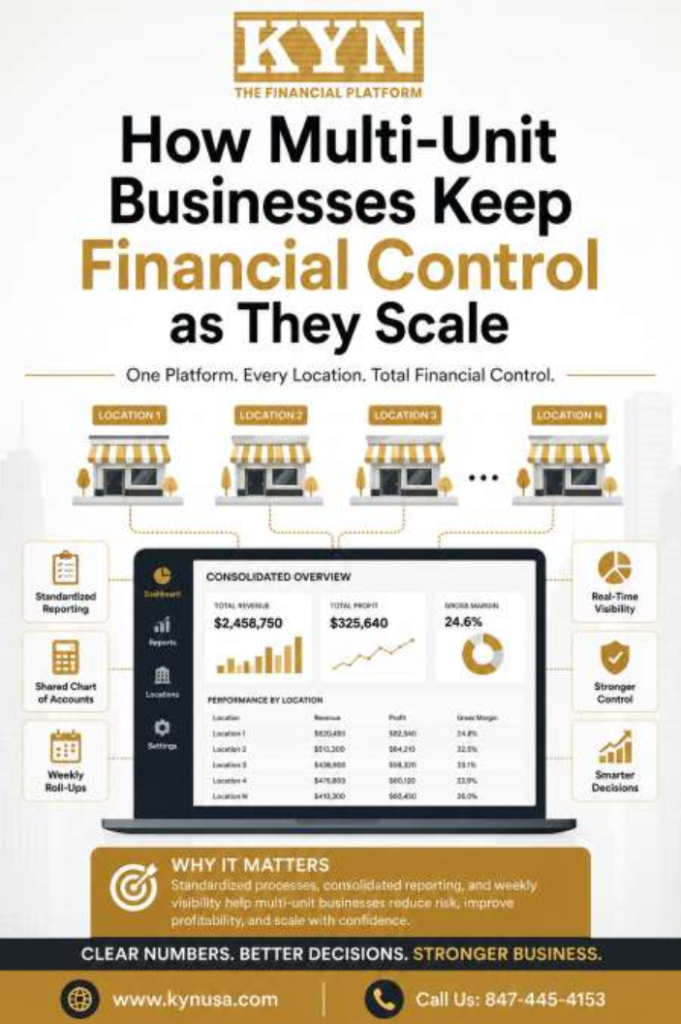
Each location tells only part of the story; executives need one complete picture. That’s where
consolidated financials for growing businesses become essential.
Instead of opening ten separate reports, leadership reviews total company revenue, company-wide
expenses, overall profitability, regional performance, and the best- and lowest-performing locations —
in one dashboard that replaces dozens of disconnected spreadsheets.
For a deeper walkthrough of how consolidation works in practice, see Multi-Location Reporting
Explained.
Why Do Weekly Roll-Ups Beat Month-End Reviews?
Waiting until month-end is too late — problems grow quickly. High-performing organizations run a
weekly Consolidated Roll-Up: every location’s numbers, rolled into one view, reviewed on the same
day each week.
Each week they review revenue trends, labor percentage, operating costs, profit margins, cash flow,
and budget performance. Weekly reporting helps leadership identify issues while they cost hundreds —
not after they’ve cost thousands.
How Do You Compare Locations Fairly?
Not every location performs equally, and without standardized reporting it’s difficult to know why.
Once reporting becomes consistent, executives can compare sites on identical terms:
| KPI | North | South | East | West |
|---|---|---|---|---|
|
Revenue |
$520K |
$480K |
$505K |
$445K |
|
Gross Margin |
44% |
42% |
46% |
39% |
|
Labor Cost |
26% |
29% |
25% |
33% |
|
Net Profit |
17% |
14% |
19% |
10% |
Now leadership immediately sees which locations outperform, which managers need support, which
markets require attention, and where costs are creeping. In this example, West’s 33% labor cost is the
first conversation to have — and you found it in seconds. This is the value of multi-site business
reporting.
For what this shift feels like operationally, read What Changes When You Go From 1 Location to 10
Locations.
Which KPIs — and Which Tools — Matter Most?
Growing businesses should avoid tracking hundreds of metrics. Monitor a core set of company-wide
KPIs — revenue growth, gross profit margin, operating margin, labor percentage, cash flow, EBITDA,
inventory turnover, average transaction value, and net profit — and make sure every location measures
them with the same formulas.
Then automate the data collection. Modern finance systems pull directly from accounting platforms,
payroll software, POS and ERP systems, inventory tools, and banking platforms. Automation cuts
human error, duplicate work, reporting delays, and spreadsheet dependency — so your finance team
spends its time analyzing numbers instead of gathering them.
What Common Mistakes Should Growing Businesses Avoid?
1. Every location using different reports and expense categories.
2. Waiting until month-end for financial reviews.
3. Relying on disconnected spreadsheets as the system of record.
4. Measuring different KPIs (or different formulas) across locations.
5. Making decisions without consolidated reporting.
6. Ignoring cash flow until problems appear.
7. Leaving managers out of the numbers entirely.
That last one matters most. Financial control isn’t only software — it’s accountability. Each location
manager should own revenue targets, expense budgets, payroll expectations, profit goals, and weekly
KPIs. When managers own their numbers, performance improves across the organization.
Best Practices for Long-Term Financial Control
• Maintain one standardized Chart of Accounts.
• Use identical financial reports across every location.
• Schedule weekly financial roll-ups.
• Automate data collection wherever possible.
• Build centralized executive dashboards.
• Compare locations using the same KPIs and formulas.
• Give every manager ownership of their numbers.
• Make decisions from one trusted source of truth.
Final Thoughts
Growth should increase opportunity — not confusion. As businesses expand into multiple locations,
regions, teams, or revenue streams, maintaining visibility becomes one of leadership’s greatest
challenges.
The organizations that keep growing invest early in multi-unit business financial control: standardized
reporting, a shared Chart of Accounts, automated data collection, and a weekly Consolidated Roll-Up
that monitors every location from a single dashboard. Whether you operate five locations or fifty, that
consistency lets you compare performance fairly, catch issues faster, and make confident decisions
from accurate, timely information.
Strong financial control doesn’t slow growth — it enables sustainable, profitable expansion. We
watched it work across 170+ restaurant locations, and it will work in your industry too.
FAQs
1 What is multi-unit business financial control?
2 Why is a shared Chart of Accounts important?
3 What are consolidated financials for growing businesses?
4 How often should multi-location businesses review financial reports?
5 Which industries benefit from multi-site business reporting?
6 At what point does a restaurant group need centralized financial reporting?
Ready to take control?
➤ Download the Free Multi-Location Control Checklist
➤ Read the Guide: What Does “Know Your Numbers” Mean?
Get one number that matters in your inbox every week — subscribe to the KYN newsletter.
Call us: 847-445-4153 Visit: www.kynusa.com
By the KYN Operating Team — built by operators who have run 170+ restaurant locations.
Sources
• Raymond R. Panko, University of Hawaii — “What We Know About Spreadsheet Errors”
(panko.com)
• AFP — FP&A Benchmarking Survey, 2025 (afponline.org)
• McKinsey & Company — AI in finance: time spent on data requests and reporting, 2024
(mckinsey.com)