

Profit Is an Opinion. Cash Is a Fact | KYN USA
 Aug 22,2026
Profit Is an Opinion. Cash Is a Fact.
Every business owner wants to be profitable.
After all, profit is often viewed as the ultimate measure of success. Investors celebrate it. Accountants
report it. Business owners chase it.
But here’s a reality that every successful operator eventually learns:
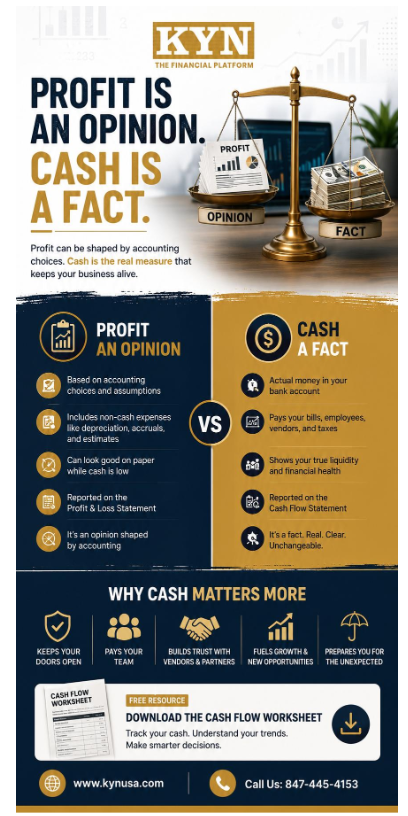
Profit is an opinion. Cash is a fact.
The saying is often credited to finance professor Alfred Rappaport, and decades of real-world business
failures keep proving it right. A widely cited U.S. Bank study found that 82% of small businesses fail
because of poor cash flow management—not because they weren’t profitable on paper.
A company can report impressive profits and still struggle to pay employees, vendors, rent, or taxes. On
the other hand, a business with modest profits but strong cash management can continue growing,
investing, and surviving economic uncertainty.
Understanding the relationship between profit vs cash flow is essential for making smarter financial
decisions.
At KYN (Know Your Numbers), we believe that knowing your cash position every day—not just your
monthly profit—is what separates confident operators from reactive ones

Why Profit Is an Opinion
Profit isn’t fake.
But it is influenced by accounting rules and assumptions.
Different accounting methods can produce different profit numbers—even when the cash entering the
business stays exactly the same.
That’s why people say:
Profit is an opinion because accounting contains judgment.
Several accounting decisions affect reported profit:
• Revenue recognition timing
• Expense matching
• Depreciation schedules
• Inventory valuation
• Amortization
• Accrual accounting adjustments
• Estimated bad debt
• Prepaid expenses
Each of these follows legitimate accounting standards.
However, they also require assumptions.
That’s why two accountants reviewing the same business could produce slightly different profit figures
while the company’s bank balance never changes
Cash Is a Fact
Cash doesn’t require interpretation.
It’s simply the money available in your bank account today.
Your bank balance is the business cash reality that no accounting adjustment can change.
Cash answers practical questions like:
• Can payroll be processed Friday?
• Can vendor invoices be paid?
• Can new equipment be purchased?
• Can another location be opened?
• Can unexpected repairs be handled?
These questions aren’t answered by net income.
They’re answered by available cash.
That’s why cash is a fact.
Profit vs Cash Flow: What's the Difference?
Many business owners confuse profit with cash flow.
They’re closely related—but they’re not the same
| Profit | Cash Flow |
|---|---|
|
An accounting measurement |
The actual movement of money |
|
Appears on the Profit & Loss Statement |
Appears on the Cash Flow Statement |
|
Includes non-cash expenses |
Tracks real cash entering and leaving |
|
Based on accrual accounting |
Based on actual payments |
|
Can be positive while cash is negative |
Shows true liquidity |
A business can have:
• Positive profit and negative cash flow
• Or a negative accounting profit and strong cash reserves
Understanding profit vs cash flow helps explain why businesses sometimes fail despite appearing
profitable. In fact, research compiled by Intuit QuickBooks has found that a majority of small business
owners regularly struggle with cash flow—even while their books show a profit.
The Hidden Danger of Accrual Accounting
One reason profit becomes an opinion is accrual accounting.
Under accrual accounting:
• Revenue is recognized when earned—not necessarily when paid.
• Expenses are recognized when incurred—not necessarily when paid.
Imagine this scenario:
A business invoices a client for $150,000. Accounting immediately records that revenue. The Profit &
Loss statement looks fantastic.
But the customer won’t actually pay for another 90 days.
Meanwhile, payroll, rent, utilities, insurance, and suppliers must still be paid this month.
The company appears profitable. Yet cash is disappearing every day.
This is why understanding accrual vs cash accounting is so important.
Why Businesses Run Out of Cash
Many owners believe businesses fail because they aren’t profitable.
In reality, many businesses fail because they run out of cash.
Common reasons include:
Slow customer payments
Sales increase. Receivables increase. Cash doesn’t.
Inventory growth
Inventory ties up cash long before products are sold.
Payroll expansion
Hiring supports growth—but payroll requires immediate cash.
Equipment purchases
Capital investments reduce cash immediately. Accounting spreads the expense through depreciation.
Debt repayments
Loan principal reduces cash. But principal isn’t an expense on the Profit & Loss statement. This creates another gap between profit and cash.
Why Cash Matters More Than Profit
Profit measures performance. Cash determines survival.
Without cash:
• Employees cannot be paid.
• Vendors stop delivering.
• Rent becomes overdue.
• Marketing slows.
• Growth stops.
• Operations suffer.
Cash provides flexibility. Profit provides confidence. Healthy businesses need both.
But when forced to choose which number deserves daily attention, cash usually wins.
That’s why many experienced operators say:
Revenue is vanity. Profit is opinion. Cash is reality.
A Restaurant Group Example
Imagine two restaurant groups, each running three locations.
Restaurant Group A
• Combined annual profit: $350,000
• Cash in bank: $8,000
• Vendor payments overdue at two locations
• Payroll stress every other week
• Tax payments approaching
Restaurant Group B
• Combined annual profit: $220,000
• Cash in bank: $275,000
• Vendors paid early
• Expansion fund available for a fourth location
• Emergency reserve established
Which business is healthier?
Most experienced operators would choose Group B.
Because healthy cash creates options. Profit alone doesn’t.
When You Run More Than One Location
Cash problems get harder to see as you grow.
In a multi-location business, the consolidated P&L can look healthy while one location quietly burns the
cash the others generate. The strong stores subsidize the weak one, and by the time the problem shows
up in a monthly report, it has been draining the group for weeks.
That’s why multi-unit operators—restaurants, franchises, retail chains, service businesses—need to see
cash location by location, not just at the top of the roll-up.
Questions every multi-location operator should be able to answer today:
• Which location generates the strongest cash flow?
• Which location consumes more cash than it produces?
• If one unit’s cash dried up tomorrow, how long could the group carry it?
The Numbers Every Business Should Watch
Instead of focusing only on monthly profit, track these numbers consistently:
• Daily cash balance
• Weekly cash flow
• Accounts receivable
• Accounts payable
• Labor cost
• Prime cost
• Operating expenses
• Gross margin
• EBITDA
• Net operating cash
These metrics reveal the true financial health of your business.
Knowing Your Numbers Means Knowing Your Cash
At KYN, we believe financial visibility should never arrive 30 days late.
Business owners need answers today. Questions like:
• How much cash do we actually have?
• Can we afford another hire?
• Which location generates the strongest cash flow?
• Which expenses are increasing?
• Are margins improving?
• Where is cash leaking?
Knowing these numbers every week—or even every day—helps leaders make faster and smarter
decisions.
How KYN Helps Businesses Stay Cash-Healthy
KYN was built for operators who need financial clarity without waiting for month-end reports.
With KYN, businesses can:
• Monitor cash performance across every location
• Compare financial trends weekly
• Track labor and prime cost
• Identify cash flow risks early
• Standardize reporting
• Make decisions using real-time financial visibility
Instead of reacting to yesterday’s reports, leaders stay ahead of today’s numbers.
That’s the KYN approach.
Final Thoughts
The phrase “Profit Is an Opinion. Cash Is a Fact.” isn’t meant to dismiss profit.
Profit absolutely matters. It measures whether your business creates value over time.
But profit alone doesn’t pay employees. Profit doesn’t cover rent. Profit doesn’t keep suppliers happy.
Cash does.
The strongest businesses understand both numbers—and never allow a profitable income statement to
hide a cash problem.
If you truly want to know your numbers, start with your cash.
Because while accounting tells a story…
Cash tells the truth.
FAQs
1 Who said “profit is an opinion, cash is a fact”?
2 Is profit more important than cash?
3 Why is profit considered an opinion?
4 What is the difference between profit vs cash flow?
5 Why does cash matter more than profit?
6 How can businesses improve cash flow?
Download Your Free Cash Flow Worksheet
Understanding your cash position starts with tracking it consistently.
Download the KYN Cash Flow Worksheet to monitor cash inflows, cash outflows, operating expenses,
and weekly cash trends. It’s a simple tool designed to help you make better financial decisions and avoid
hidden cash flow problems before they affect your business.