

How to Know If You’re Financially Ready to Open a Second Location
KYN Insights
Operator Playbooks · Mohan Patel
Cash Clarity for Multi-Location Operators
6
Series · Cash Clarity for Multi-Location Operators
Part 5 of 6
How to Know If You’re Financially Ready to Open a Second Location
Growth should be earned by the numbers, not the excitement. Here are the five checkpoints — and the exact figures — that tell you whether your business is ready for a second location.

Mohan Patel
Founder, KYN
On this page
The first time I opened a second location, I did it for all the right-sounding reasons and one wrong one. The right-sounding reasons: my first store was busy, the brand was working, and a great space opened up in a great spot. The wrong one: I was excited, and I let the excitement do the math.
On paper the first location looked successful. What I hadn’t honestly asked was whether it threw off consistent cash, whether it could run without me in the building every day, and whether I had the reserves to carry a second store through the months before it found its feet. The answer to all three, if I’d looked, was “not quite.”
The second location didn’t fail — but it stretched me thin in a way I still remember. For months I was robbing one store to feed the other, working both floors, and watching my cash gap widen exactly the way I’d later warn other operators about. It worked out. It didn’t have to.
Years later, when I expanded again, I did it completely differently: I let the numbers decide. Same ambition, none of the white-knuckle months — because this time the business had earned the move before I made it.
That’s the difference this article is about. Expansion is one of the highest-stakes decisions an operator makes, and most people make it on momentum. There’s a better way — and it starts by being honest about a handful of numbers.
The Short Answer
THE SHORT ANSWER — YOU’RE READY WHEN
- Your existing location consistently generates positive cash flow — not just profit on paper.
- Your prime cost (food + labor) is under control and steady.
- Your working capital is healthy, with a short cash conversion cycle.
- The first location runs well without your constant, in-the-building intervention.
- You have cash reserves that can fund the new store’s entire ramp-up.
- Weekly financial reporting is already a habit, so you’ll see trouble early.
If you can honestly check all six, the business has earned the right to grow. If you can’t, the gaps below are your pre-expansion to-do list — not a reason to abandon the dream, just a reason to get ready first.
Growth Should Be Earned by the Numbers, Not the Emotions
Almost every expansion that gets an operator in trouble started the same way mine did: with a feeling. A great location opened up. A competitor expanded. A strong year made it feel like the right time. None of those are numbers — they’re emotions wearing a business suit.
The excitement isn’t the problem; letting it make the decision is. A second location doesn’t just double your upside — it doubles your fixed costs, your payroll runs, your cash gaps, and the number of places a problem can start, all while the new store spends months in the red before it ramps. If the first location can’t comfortably absorb that, the second one doesn’t add a store; it puts two at risk.
“Growth should be earned by the numbers, not the emotions. The excitement tells you that you want to grow; only the numbers tell you that you can.”
The good news: “ready” isn’t a mystery or a gut feeling. It’s a small set of checkpoints you can actually measure.
The KYN Expansion Readiness Score™
Over the years I boiled expansion readiness down to five checkpoints. Think of them as steps you climb — each one has to hold your weight before the next. If even one is weak, you’re not ready yet.
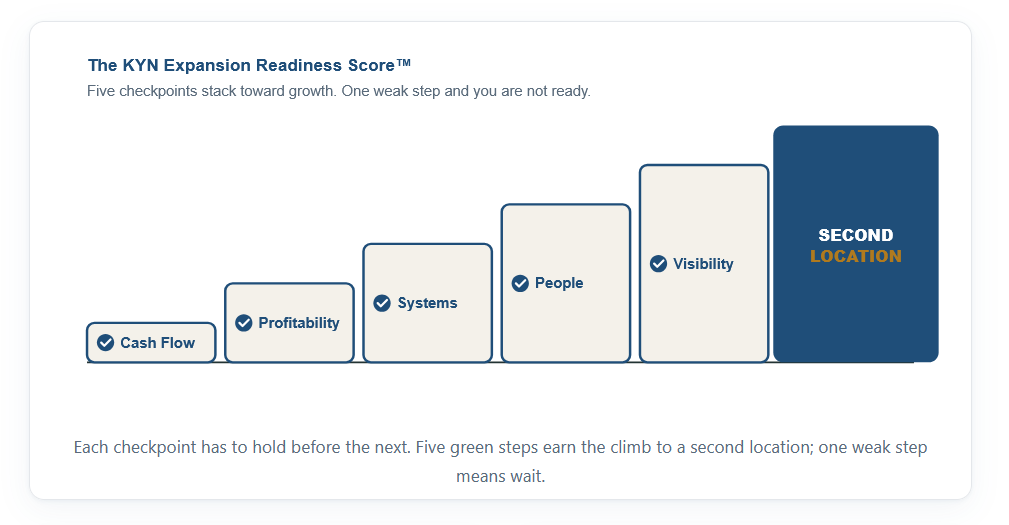
1
Cash Flow
The first location throws off consistent, positive cash — not one good month, but a reliable pattern you can count on to help carry the second.
2
Profitability
Prime cost and margins are under control and steady. You’re expanding a model that works, not hoping scale will fix one that doesn’t.
3
Systems
Ordering, scheduling, reporting, and standards run on process, not on you. Systems are what you’ll actually be copying into store two.
4
People
You have a bench — a manager who can run location one so you can be at location two. Growth dies fastest when the owner is the only operator.
5
Visibility
You already see your numbers weekly and forecast cash ahead. You can’t manage two locations on month-end reports you couldn’t manage one on.
The Numbers Behind Each Checkpoint
“Ready” has to mean something specific. Here’s what to actually look at:
- Consistent positive cash flow — not a profitable month, but several months where cash in the bank genuinely grows after everything is paid. One good quarter isn’t a pattern.
- Prime cost under control — food plus labor holding steady in a healthy range for your concept, week after week. If it still swings unpredictably at one store, two will be worse.
- Healthy working capital — a short cash conversion cycle and cash that isn’t all trapped in inventory and receivables (see Part 3). Expansion needs free cash, not cash you’re chasing.
- Reserves sized to the ramp — the big one. Know how many months the new location will run cash-negative and set that money aside before you sign — typically several months of the new store’s operating costs, on top of what location one needs. Model it with a 13-week forecast (see Part 2) so the tight weeks are visible before they arrive.
- An owner-independent first store — if location one dips every time you leave the floor, you don’t have a system yet; you have a job. Fix that before you split your attention.
Notice that four of the five checkpoints are things the first four articles in this series already taught you to build. Expansion readiness isn’t a new skill — it’s the payoff for doing the fundamentals.
What This Looks Like in Real Life
Two operators, same year, same ambition. The first found a great location and signed fast — his first store was profitable and it felt like now-or-never. Six months in he was funding the new store’s ramp off his personal credit and pulling doubles at both. It survived, but the stress was brutal and avoidable.
The second wanted to move just as badly but ran the checkpoints first. Two were weak: his first store still leaned on him daily, and his reserves wouldn’t cover the full ramp. So he waited two quarters — trained a manager, built the cushion — then opened. His second location ramped without drama, because the base could carry it. Same goal, same market. One let the numbers decide; the other let the excitement. (Illustrative, drawn from a pattern I’ve seen many times.)
The Mistakes That Sink a Second Location
- Growing on emotion or opportunity. “A great space opened up” is not a readiness signal. The space will be less important than the base you build it on.
- Under-capitalizing the ramp. The most common killer: opening with enough to build the store but not enough to carry it through months of negative cash while it finds its feet.
- Expanding a first store that still needs you. If location one can’t run without the owner, a second location just means one owner spread across two struggling stores.
- Confusing profit with readiness. A profitable P&L is necessary but not sufficient. Cash flow, reserves, and systems decide whether you survive the ramp.
- Flying without weekly visibility. If you can’t see one location clearly every week, two will blindside you twice as fast.
What I Finally Did About It
After stretching myself thin the first time, I never wanted to guess at readiness again — for myself or the operators I worked with. The trouble is that the five checkpoints live in five different places: cash flow in the bank, prime cost in the POS, working capital in the books, reserves in a forecast, and “can it run without me” in your own honest judgment. Pulling that together by hand, right when you’re emotionally invested in a yes, is exactly when people fool themselves.
So I built it into the platform. On the hard rule that your books are clean and reconciled first, the KYN Financial Platform shows the readiness picture in one place — consistent cash flow, prime cost, working capital, and a 13-week model of the new store’s ramp against your actual reserves. It turns “I think we’re ready” into “here are the numbers that say we are, and here’s the one that says wait.”
I ran my own expansions on exactly this discipline for five years before offering it to anyone else. The second time I grew, the numbers went first — and the white-knuckle months never came.
The KYN Decision Framework
Every article in this series comes back to the same five-step loop — the one I run my own business on:
THE KYN DECISION FRAMEWORK
- Know Your Books — start from clean, reconciled numbers. Nothing downstream works without this.
- Know Your Numbers — see cash and profit together, across every location.
- See the Trend — look weeks ahead, not just back at last month.
- Make the Decision — act while you still have room to change the outcome.
- Review Every Week — make it a standing habit, not a fire drill.
Key Takeaways
THE 5 THINGS TO REMEMBER
- The weekly numbers habit beats month-end because it lets you act while problems are still small.
- Build a short dashboard: cash & runway, sales vs. forecast, prime cost, labor %, the 13-week outlook, and profit-and-cash together.
- If a number won’t change a decision this week, keep it off the weekly view.
- Run the KYN Weekly Decision Cycle: update, review, correct, monitor, plan — one move a day.
- The rhythm is the point. Same day, same numbers, every week — that consistency is the edge.
Common Questions
1 How do I know if I’m ready to open a second location?
2 How much cash do I need to open a second restaurant location?
3 Should I open a second location just because my first one is profitable?
4 What is prime cost and why does it matter before expanding?
5 What is the biggest mistake when opening a second location?
The excitement tells you that you want to grow. Only the numbers tell you that you can. Right Numbers. Right Time. Right Decisions.
Not sure where you stand on the five checkpoints? Book a KYN expansion readiness review and I’ll walk you through it personally — we’ll score your readiness and model your next location’s ramp against your real reserves.
GET THE TOOL
Thinking about location two? Download the free Second Location Financial Checklist — the five readiness checkpoints and the exact numbers to hit before you sign a lease.
IF YOU REMEMBER ONE THING
Don’t let a great opportunity make the decision a great business should. Earn the second location with your numbers first — then the excitement is justified.
Numbers don’t make decisions. Owners do. The right numbers simply help you make the right one.