


KYN Insights
Operator Playbooks · Mohan Patel
Cash Clarity for Multi-Location Operators
6
01
Cash Flow vs. Profit: Why Growing Operators Run Out of Money
02
The 13-Week Cash Flow Forecast: Seeing Trouble Before It Arrives
03
Working Capital & the Cash Conversion Cycle: Freeing Up Cash You Already Have
04
The Weekly Numbers Habit: Building an Operator’s Dashboard
05
How to Know If You’re Financially Ready to Open a Second Location
06
From Clean Books to Clear Decisions: Turning Data Into Action
Series · Cash Clarity for Multi-Location Operators
Part 6 of 6
From Clean Books to Clear Decisions: Turning Data Into Action
Every playbook in this series stands on one foundation: numbers you can trust. Here’s why clean books come first — and how good data becomes better decisions.

Mohan Patel
Founder, KYN · December 1, 2026 · 9 min read
On this page
Early on, I made a decision I was sure about. The numbers said one of my locations was carrying the others, so I poured attention and money into it and eased off the rest. It felt data-driven. It was — except the data was wrong.
My books were weeks behind and stitched together across a couple of spreadsheets and a shoebox of good intentions. When they finally got cleaned up and reconciled, the picture flipped: the “star” location was actually the thin one, and two I’d eased off were quietly carrying the business. I had made a confident decision on numbers that simply weren’t true.
That stung more than the $122 month, because this time the problem wasn’t that I couldn’t see the numbers — it’s that I trusted numbers I shouldn’t have. I’ve seen it in hundreds of businesses since: the issue usually isn’t a lack of data. It’s data nobody can trust.
It taught me the rule that sits underneath this whole series: a dashboard built on messy books isn’t insight — it’s fast, confident, expensive garbage. Everything I’ve written about — the cash gap, the forecast, working capital, the weekly habit, knowing when to grow — assumes one thing underneath it: books you can actually believe.
This final article is about that foundation, and how clean data turns into clear decisions.
The Short Answer
THE SHORT ANSWER
Every good decision runs downhill from clean books. If your numbers aren’t accurate, reconciled, and current, every tool built on them — dashboards, forecasts, cash-gap analysis, expansion math — inherits the error and hands you confident, wrong answers. Clean books aren’t the boring part of finance; they’re the foundation that makes every other decision trustworthy. Get the data right first, then turn it into action.
This is the piece that ties the series together — because none of the other five work without it.
Why Clean Books Come First
There’s a reason “garbage in, garbage out” has survived as a cliché: it’s ruthlessly true in finance. A beautiful dashboard doesn’t make numbers correct — it just makes wrong numbers look authoritative. And wrong numbers you trust are more dangerous than no numbers at all, because they move you to act with false confidence.
And it’s expensive. Gartner estimates poor data quality costs organizations an average of $12.9 million a year — and the damage usually isn’t missing data, it’s confident decisions made on inaccurate data.
Clean books mean three things: your accounts are reconciled to what actually happened in the bank, your transactions are categorized consistently, and the whole thing is current — not six weeks behind. When those three hold, a number you read is a fact. When they don’t, every downstream tool is guessing in a nicer font.
“A dashboard built on messy books isn’t insight. It’s fast, confident, expensive garbage.”
If anything, this matters more now, not less. Every operator is being told AI will change the game — and it will, but only on top of good data. AI can summarize your reports, surface trends, and answer questions in seconds; what it can’t do is fix inaccurate bookkeeping. It’s only ever as good as the numbers you feed it. Clean books remain the foundation of every intelligent decision — human or machine.
This is why, throughout this series, I’ve treated clean, reconciled books as a hard rule rather than a nice-to-have. It’s not the exciting part. It’s the part everything else depends on.
The KYN Data-to-Decision Pipeline™
Good decisions aren’t a single event — they’re the end of a pipeline. Each stage depends entirely on the one before it, and it starts with the books:
The KYN Data-to-Decision Pipeline™
Clean Books
Trusted Numbers
Clear Visiability
Confident Decisions
Better Result
Every step depends on the one before it — it all starts with clean books.
Break the first link and the whole chain breaks quietly — you still get decisions at the end, they’re just built on sand.
Read it left to right. Clean books produce trusted numbers. At KYN, that first link is the start of everything we mean by Right Numbers. Right Time. Right Decisions. Trusted numbers give you clear visibility — cash and profit you can actually see. Visibility enables confident decisions, made while you still have time to act. And confident decisions, repeated week after week, compound into better results. Break the first link and the whole chain breaks quietly — you still get decisions at the end, they’re just built on sand.
This is the whole reason KYN is a Financial Performance Platform and not just bookkeeping: clean books are step one, but the payoff is the performance that trustworthy numbers unlock.
Are Your Books Decision-Ready?
Check what’s genuinely true today. If you can’t tick these, your numbers aren’t ready to bet decisions on.
Turning Data Into Action
Clean books aren’t the goal — they’re the fuel. The goal is action. And once your numbers are trustworthy, everything else in this series becomes a decision you can actually make:
- See the cash gap (Part 1) — because profit and cash are both real numbers, read together.
- Run a 13-week forecast (Part 2) — because you can trust the balances and timing feeding it.
- Free trapped working capital (Part 3) — because your inventory, receivables, and payables days are accurate.
- Run the weekly numbers habit (Part 4) — because the dashboard reflects reality, not a guess.
- Know when to grow (Part 5) — because readiness is measured on numbers you believe.
That’s the whole series in one line: clean books, seen clearly, turned into weekly decisions, across every location. Data doesn’t manage your business. Decisions do — and good decisions need data you can trust.
And it reaches beyond the kitchen. For an accountant or advisor managing dozens of clients, the same rule holds: without consistent, reconciled books underneath, even the best advisory work becomes guesswork.
What This Looks Like in Real Life
An operator I worked with was drowning in reports and still flying blind — three locations, three different ways of keeping the books, numbers that never quite agreed. He wasn’t short on data; he was short on data he could trust, so he defaulted to gut calls.
We didn’t hand him a fancier dashboard first. We cleaned and reconciled the books and put all three locations on one source of truth. Then the dashboard meant something. Within a couple of months he was making the same kinds of weekly decisions this series describes — but now they were grounded, and they held up. Same operator, same locations. The difference was a foundation he could stand on. (Illustrative, drawn from a pattern I’ve seen many times.)
The Mistakes That Turn Data Into Noise
- Building dashboards on messy books. Faster wrong answers aren’t progress. Fix the foundation before you decorate it.
- Letting the books fall behind. Numbers that are six weeks stale can’t drive this-week decisions, no matter how clean they eventually get.
- Keeping several sources of truth. Two spreadsheets that disagree mean you have zero numbers you can trust. Consolidate to one.
- Treating bookkeeping as compliance. Books aren’t just for taxes and the accountant. They’re the raw material of every decision you make.
What I Finally Did About It
After making a confident call on numbers that turned out to be wrong, I never wanted to build another decision on a foundation I couldn’t trust. But I also knew the truth: clean books are where most operators quietly give up, because reconciling and maintaining them across locations is relentless, unglamorous work.
So I built the platform to treat it as the starting line, not an afterthought. The KYN Financial Platform runs on one hard rule: the books are clean and reconciled first. From that foundation it turns your numbers into the whole series — cash and profit visibility, the 13-week forecast, working capital, the weekly dashboard, expansion readiness — one trustworthy source, across every location. I built it to a simple standard — Simple, Secure & Smart: simple, because a dashboard that drowns you in complicated AI gimmicks never gets used — the job is to turn reconciled data into a straightforward weekly action plan; secure, because it’s your financial data; and smart, because the point is better decisions, not more charts. Clean data you can’t see doesn’t help you; a dashboard on messy books actively hurts you. You need both, and that combination is the entire point of KYN.
I ran my own business on it for five years before offering it to anyone else — and it always started the same way: get the books right, then let the decisions get easy.
The KYN Decision Framework
Every article in this series comes back to the same five-step loop — the one I run my own business on:
THE KYN DECISION FRAMEWORK
- Know Your Books — start from clean, reconciled numbers. Nothing downstream works without this.
- Know Your Numbers — see cash and profit together, across every location.
- See the Trend — look weeks ahead, not just back at last month.
- Make the Decision — act while you still have room to change the outcome.
- Review Every Week — make it a standing habit, not a fire drill.
Key Takeaways
THE 5 THINGS TO REMEMBER
- Every decision runs downhill from clean books — if the data’s wrong, every tool built on it is wrong too.
- A dashboard on messy books isn’t insight; it’s fast, confident, expensive garbage.
- Clean means reconciled, consistently categorized, and current — not six weeks behind.
- The pipeline: clean books → trusted numbers → clear visibility → confident decisions → better results.
- Data doesn’t run your business; decisions do — and good decisions need numbers you can trust.
Common Questions
1 Why do clean books matter for decision-making?
2 What does it mean to reconcile your books?
3 Can I use a financial dashboard if my books aren’t clean?
4 How often should a restaurant reconcile its books?
5 What’s the difference between bookkeeping and financial visibility?
Data doesn’t run your business. Decisions do — and the best decisions start with numbers you can trust. Right Numbers. Right Time. Right Decisions.
Want to build every decision on numbers you can trust, across every location? Book a KYN demo and I’ll walk you through it personally — from clean books to clear decisions.
GET THE TOOL
Want to check your foundation? Download the free Decision-Ready Books Checklist — the reconciliation and data-quality steps that make your numbers trustworthy enough to act on.
IF YOU REMEMBER ONE THING
Fix the foundation before you decorate it. Clean, reconciled, current books turn every other number you look at from a guess into a decision you can make with confidence.
Numbers don’t make decisions. Owners do. The right numbers simply help you make the right one.
THAT COMPLETES THE SERIES
Businesses don’t fail because owners don’t work hard. They fail because they make decisions with incomplete numbers. That’s why KYN exists — to make sure every important decision begins with numbers you can trust.
You’ve reached the end of Cash Clarity for Multi-Location Operators — six playbooks that move from understanding the cash gap to running your whole business on trustworthy numbers. Start again at Part 1, or use the index to revisit any chapter.
← Previous
How to Know If You’re Ready to Open a Second Location
Series complete ✓
Back to the library index
Reviewed and updated periodically as best practices and regulations evolve.
Continue Reading — The Series
Cash Clarity for Multi-Location Operators, in order. All six chapters are live.
Mohan Patel
Founder, KYN USA
Mohan Patel has spent more than 30 years in the trenches of multi-location operations. He founded KYN after watching too many profitable operators get blindsided by cash, and he still runs his own business on the platform every week — because better decisions start with better visibility.
KYN is the Financial Performance Platform for multi-location operators.
Series · Cash Clarity for Multi-Location Operators
Part 5 of 6
How to Know If You’re Financially Ready to Open a Second Location
Growth should be earned by the numbers, not the excitement. Here are the five checkpoints — and the exact figures — that tell you whether your business is ready for a second location.
Mohan Patel
Founder, KYN · December 1, 2026 · 9 min read
On this page
The first time I opened a second location, I did it for all the right-sounding reasons and one wrong one. The right-sounding reasons: my first store was busy, the brand was working, and a great space opened up in a great spot. The wrong one: I was excited, and I let the excitement do the math.
On paper the first location looked successful. What I hadn’t honestly asked was whether it threw off consistent cash, whether it could run without me in the building every day, and whether I had the reserves to carry a second store through the months before it found its feet. The answer to all three, if I’d looked, was “not quite.”
The second location didn’t fail — but it stretched me thin in a way I still remember. For months I was robbing one store to feed the other, working both floors, and watching my cash gap widen exactly the way I’d later warn other operators about. It worked out. It didn’t have to.
Years later, when I expanded again, I did it completely differently: I let the numbers decide. Same ambition, none of the white-knuckle months — because this time the business had earned the move before I made it.
That’s the difference this article is about. Expansion is one of the highest-stakes decisions an operator makes, and most people make it on momentum. There’s a better way — and it starts by being honest about a handful of numbers.
The Short Answer
THE SHORT ANSWER — YOU’RE READY WHEN
- Your existing location consistently generates positive cash flow — not just profit on paper.
- Your prime cost (food + labor) is under control and steady.
- Your working capital is healthy, with a short cash conversion cycle.
- The first location runs well without your constant, in-the-building intervention.
- You have cash reserves that can fund the new store’s entire ramp-up.
- Weekly financial reporting is already a habit, so you’ll see trouble early.
If you can honestly check all six, the business has earned the right to grow. If you can’t, the gaps below are your pre-expansion to-do list — not a reason to abandon the dream, just a reason to get ready first.
Growth Should Be Earned by the Numbers, Not the Emotions
Almost every expansion that gets an operator in trouble started the same way mine did: with a feeling. A great location opened up. A competitor expanded. A strong year made it feel like the right time. None of those are numbers — they’re emotions wearing a business suit.
The excitement isn’t the problem; letting it make the decision is. A second location doesn’t just double your upside — it doubles your fixed costs, your payroll runs, your cash gaps, and the number of places a problem can start, all while the new store spends months in the red before it ramps. If the first location can’t comfortably absorb that, the second one doesn’t add a store; it puts two at risk.
“Growth should be earned by the numbers, not the emotions. The excitement tells you that you want to grow; only the numbers tell you that you can.”
The good news: “ready” isn’t a mystery or a gut feeling. It’s a small set of checkpoints you can actually measure.
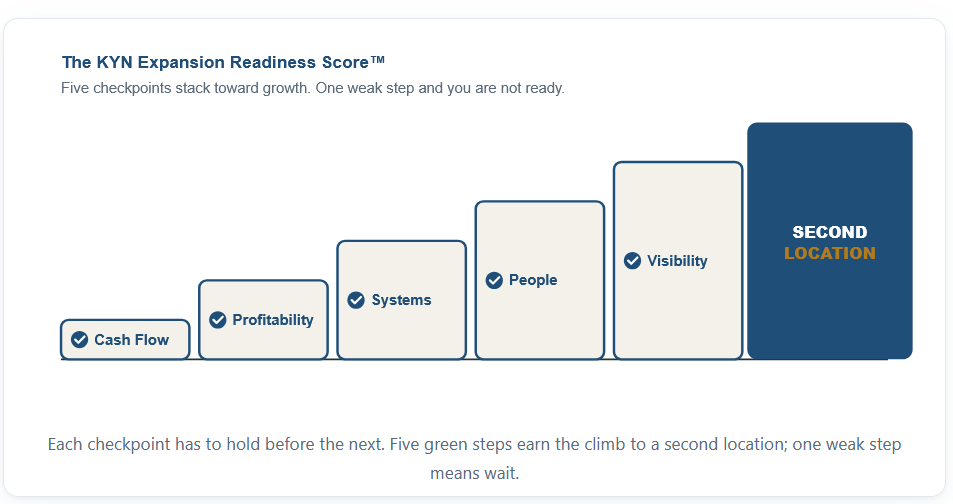
The KYN Expansion Readiness Score™
Over the years I boiled expansion readiness down to five checkpoints. Think of them as steps you climb — each one has to hold your weight before the next. If even one is weak, you’re not ready yet.
Are Your Books Decision-Ready?
Check what’s genuinely true today. If you can’t tick these, your numbers aren’t ready to bet decisions on.
The Numbers Behind Each Checkpoint
“Ready” has to mean something specific. Here’s what to actually look at:
- Consistent positive cash flow — not a profitable month, but several months where cash in the bank genuinely grows after everything is paid. One good quarter isn’t a pattern.
- Prime cost under control — food plus labor holding steady in a healthy range for your concept, week after week. If it still swings unpredictably at one store, two will be worse.
- Healthy working capital — a short cash conversion cycle and cash that isn’t all trapped in inventory and receivables (see Part 3). Expansion needs free cash, not cash you’re chasing.
- Reserves sized to the ramp — the big one. Know how many months the new location will run cash-negative and set that money aside before you sign — typically several months of the new store’s operating costs, on top of what location one needs. Model it with a 13-week forecast (see Part 2) so the tight weeks are visible before they arrive.
- An owner-independent first store — if location one dips every time you leave the floor, you don’t have a system yet; you have a job. Fix that before you split your attention.
Notice that four of the five checkpoints are things the first four articles in this series already taught you to build. Expansion readiness isn’t a new skill — it’s the payoff for doing the fundamentals.
What This Looks Like in Real Life
Two operators, same year, same ambition. The first found a great location and signed fast — his first store was profitable and it felt like now-or-never. Six months in he was funding the new store’s ramp off his personal credit and pulling doubles at both. It survived, but the stress was brutal and avoidable.
The second wanted to move just as badly but ran the checkpoints first. Two were weak: his first store still leaned on him daily, and his reserves wouldn’t cover the full ramp. So he waited two quarters — trained a manager, built the cushion — then opened. His second location ramped without drama, because the base could carry it. Same goal, same market. One let the numbers decide; the other let the excitement. (Illustrative, drawn from a pattern I’ve seen many times.)
The Mistakes That Sink a Second Location
- Growing on emotion or opportunity. “A great space opened up” is not a readiness signal. The space will be less important than the base you build it on.
- Under-capitalizing the ramp. The most common killer: opening with enough to build the store but not enough to carry it through months of negative cash while it finds its feet.
- Expanding a first store that still needs you. If location one can’t run without the owner, a second location just means one owner spread across two struggling stores.
- Confusing profit with readiness. A profitable P&L is necessary but not sufficient. Cash flow, reserves, and systems decide whether you survive the ramp.
- Flying without weekly visibility. If you can’t see one location clearly every week, two will blindside you twice as fast.
What I Finally Did About It
After stretching myself thin the first time, I never wanted to guess at readiness again — for myself or the operators I worked with. The trouble is that the five checkpoints live in five different places: cash flow in the bank, prime cost in the POS, working capital in the books, reserves in a forecast, and “can it run without me” in your own honest judgment. Pulling that together by hand, right when you’re emotionally invested in a yes, is exactly when people fool themselves.
So I built it into the platform. On the hard rule that your books are clean and reconciled first, the KYN Financial Platform shows the readiness picture in one place — consistent cash flow, prime cost, working capital, and a 13-week model of the new store’s ramp against your actual reserves. It turns “I think we’re ready” into “here are the numbers that say we are, and here’s the one that says wait.”
I ran my own expansions on exactly this discipline for five years before offering it to anyone else. The second time I grew, the numbers went first — and the white-knuckle months never came.
The KYN Decision Framework
Every article in this series comes back to the same five-step loop — the one I run my own business on:
THE KYN DECISION FRAMEWORK
- Know Your Books — start from clean, reconciled numbers. Nothing downstream works without this.
- Know Your Numbers — see cash and profit together, across every location.
- See the Trend — look weeks ahead, not just back at last month.
- Make the Decision — act while you still have room to change the outcome.
- Review Every Week — make it a standing habit, not a fire drill.
Key Takeaways
THE 5 THINGS TO REMEMBER
- Growth should be earned by the numbers, not the emotions — momentum is not a readiness signal.
- Run the KYN Expansion Readiness Score: Cash Flow, Profitability, Systems, People, Visibility. One weak checkpoint means wait.
- Profit isn’t enough — consistent cash flow, healthy working capital, and reserves for the ramp are what carry a second store.
- Size your reserves to the new location’s entire ramp-up before you sign, and model it with a 13-week forecast.
- If the first store still needs you daily, build the system before you split your attention.
Common Questions
1 How do I know if I’m ready to open a second location?
2 How much cash do I need to open a second restaurant location?
3 Should I open a second location just because my first one is profitable?
4 What is prime cost and why does it matter before expanding?
5 What is the biggest mistake when opening a second location?
The excitement tells you that you want to grow. Only the numbers tell you that you can. Right Numbers. Right Time. Right Decisions.
Not sure where you stand on the five checkpoints? Book a KYN expansion readiness review and I’ll walk you through it personally — we’ll score your readiness and model your next location’s ramp against your real reserves.
GET THE TOOL
Thinking about location two? Download the free Second Location Financial Checklist — the five readiness checkpoints and the exact numbers to hit before you sign a lease.
IF YOU REMEMBER ONE THING
Don’t let a great opportunity make the decision a great business should. Earn the second location with your numbers first — then the excitement is justified.
Numbers don’t make decisions. Owners do. The right numbers simply help you make the right one.
← Previous
The Weekly Numbers Habit
Series complete ✓
Back to the library index
Reviewed and updated periodically as best practices and regulations evolve.
Continue Reading — The Series
Cash Clarity for Multi-Location Operators, in order. All six chapters are live.
Mohan Patel
Founder, KYN USA
Mohan Patel has spent more than 30 years in the trenches of multi-location operations. He founded KYN after watching too many profitable operators get blindsided by cash, and he still runs his own business on the platform every week — because better decisions start with better visibility.
KYN is the Financial Performance Platform for multi-location operators.
Series · Cash Clarity for Multi-Location Operators
Part 4 of 6
The Weekly Numbers Habit: Building an Operator’s Dashboard
The most profitable habit in the business isn’t a metric — it’s a rhythm. Here’s the handful of numbers to watch every week, and the simple cycle that turns them into decisions.
Mohan Patel
Founder, KYN · December 1, 2026 · 9 min read
On this page
For years I ran my business the way almost everyone does: I waited for the month to close. The books would get finished a week or two into the next month, my accountant would send the P&L, and I’d sit down to find out how we did. By then, whatever had gone wrong was three, four, sometimes six weeks in the past — long past the point where I could do anything about it.
The month I found $122 in the bank after a “profitable” month was the month that habit finally broke. I realized I’d been driving by looking in the rear-view mirror, and calling it management.
So I changed one thing. Every Monday morning, before anything else, I sat down with the same short list of numbers. Not the full month-end package — just a handful of figures that told me where cash and performance actually stood, that week. It took fifteen minutes.
That fifteen-minute habit did more for my business than any report I’d ever waited a month for. Problems showed up while they were still small. Good weeks got reinforced. Decisions got made on Tuesday instead of the following month. Nothing about the business was different — only how often I looked, and how quickly I could act.
This article is about that habit: the numbers worth watching every week, and the simple cycle that turns looking into deciding.
The Short Answer
THE SHORT ANSWER — YOU’RE READY WHEN
The weekly numbers habit means reviewing a small, fixed set of operating numbers every week — cash, sales versus forecast, prime cost, labor, and your cash outlook — instead of waiting for month-end. An operator’s dashboard puts those numbers in one place so you can spot problems while they’re still small and make decisions this week, not next month. The power isn’t any single metric; it’s the rhythm.
Month-end tells you what happened. A weekly habit lets you change what happens next. Here’s how to build one.
Why Weekly Beats Monthly
Monthly financials are necessary, but as a management tool they arrive too late. By the time the books close and the P&L lands, you’re often looking at a picture that’s five or six weeks old. A bad week in the first week of the month can hide inside an average month and never get addressed until it’s repeated three more times.
Weekly changes the math entirely. A number trending the wrong way for two weeks running is a signal you can act on — reorder less, adjust a schedule, chase a collection, hold a payment. The same number seen once a month is just history. As I said earlier in this series: a number you see once a month is a eulogy; a number you see weekly is a warning you can still do something about.
“You can’t manage a business at the speed of month-end. The decisions happen weekly, so the numbers have to as well.”
The Numbers on an Operator’s Dashboard
A dashboard isn’t “every number you have.” The whole point is a short list you’ll actually look at every week. Here are the six that earn their place for most multi-location operators:
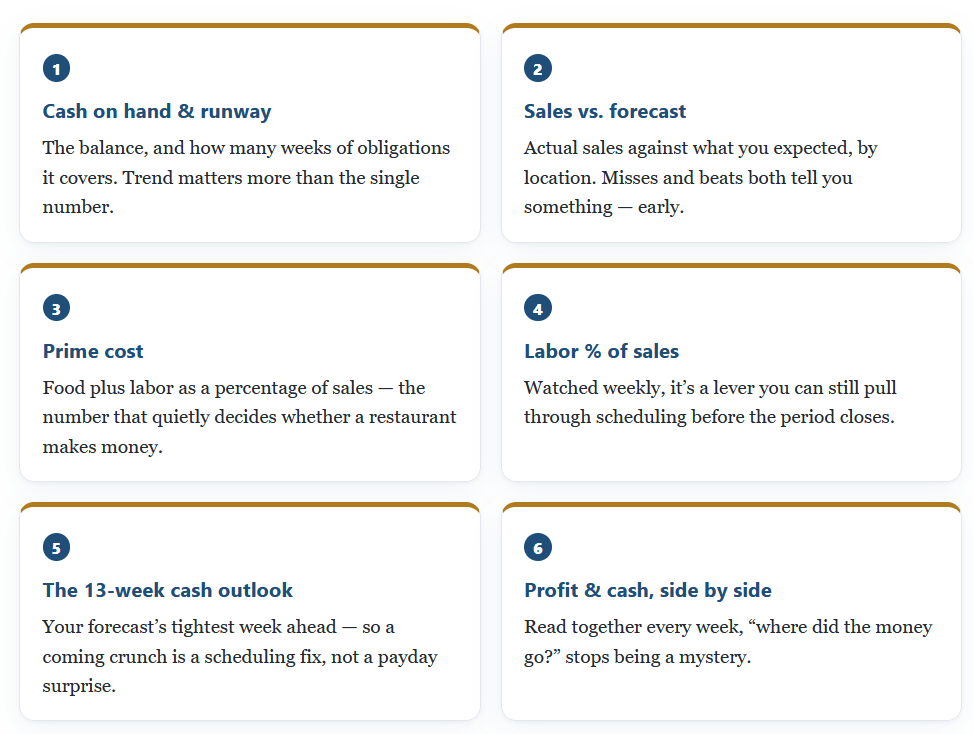
Notice what’s not here: a wall of vanity metrics. If a number won’t change a decision this week, it doesn’t belong on the weekly dashboard. Depth is for month-end; the weekly view is for action.
Are Your Books Decision-Ready?
Check what’s genuinely true today. If you can’t tick these, your numbers aren’t ready to bet decisions on.
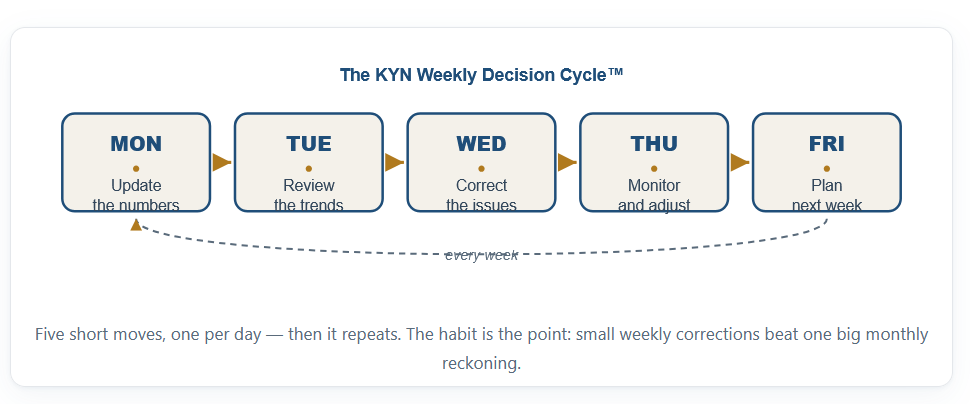
The KYN Weekly Decision Cycle™
Having the numbers isn’t the habit — using them is. Over the years I boiled the weekly rhythm down to five short moves, one per day. None of them takes long. Together they turn a dashboard into decisions:
What This Looks Like in Real Life
An operator I worked with was a classic month-end manager — sharp, experienced, but always reacting a month late. His prime cost would creep up in week one, and he wouldn’t know until the P&L landed six weeks later, by which point he’d repeated the same over-ordering four times.
We didn’t add staff or software he didn’t need. We set a standing 20-minute Monday review of six numbers and gave the week a simple rhythm. Within a couple of months, his prime cost stopped drifting — not because he worked harder, but because he was catching the creep in week one instead of week six. Same operator, same locations. He just started looking while he could still do something about it. (Illustrative, drawn from a pattern I’ve seen many times.)
The Mistakes That Break the Habit
- Only looking at month-end. The single biggest one. If your first look at a bad trend is the closed P&L, you’ve already lived it three or four times.
- Too many metrics. A dashboard with forty numbers gets ignored. Pick the handful that change decisions and cut the rest.
- Looking but not acting. A dashboard you review and don’t respond to is just anxiety with charts. The cycle only works if Wednesday actually corrects something.
- Inconsistent cadence. Every-other-week-when-I-remember isn’t a habit. Same day, same numbers, every week — the rhythm is the whole point.
What I Finally Did About It
The hard part of the weekly habit isn’t the discipline — it’s the setup. Pulling six current numbers together every Monday, across every location, from POS and payroll and the bank, is exactly the kind of manual chore that quietly kills the habit by week three. If updating the dashboard takes two hours, you won’t do it for long.
So I built the dashboard I wanted to open every Monday. That’s the KYN Financial Platform. On the hard rule that your books are clean and reconciled first, it pulls your weekly numbers into one live view across every location — cash, sales versus forecast, prime cost, labor, and the 13-week outlook — updated for you, so the habit takes minutes instead of hours. The Monday review stops being a chore and becomes a decision.
I ran my own business on that Monday rhythm for five years before I offered it to anyone else. It’s the single habit I’d least want to give up.
The KYN Decision Framework
Every article in this series comes back to the same five-step loop — the one I run my own business on:
THE KYN DECISION FRAMEWORK
- Know Your Books — start from clean, reconciled numbers. Nothing downstream works without this.
- Know Your Numbers — see cash and profit together, across every location.
- See the Trend — look weeks ahead, not just back at last month.
- Make the Decision — act while you still have room to change the outcome.
- Review Every Week — make it a standing habit, not a fire drill.
Key Takeaways
THE 5 THINGS TO REMEMBER
- The weekly numbers habit beats month-end because it lets you act while problems are still small.
- Build a short dashboard: cash & runway, sales vs. forecast, prime cost, labor %, the 13-week outlook, and profit-and-cash together.
- If a number won’t change a decision this week, keep it off the weekly view.
- Run the KYN Weekly Decision Cycle: update, review, correct, monitor, plan — one move a day.
- The rhythm is the point. Same day, same numbers, every week — that consistency is the edge.
Common Questions
1 What is a weekly numbers habit?
2 What numbers should a restaurant owner track weekly?
3 Why review numbers weekly instead of monthly?
4 What is an operator’s dashboard?
5 How many metrics should be on a dashboard?
The most valuable habit in your business takes fifteen minutes a week. Same day, same numbers, every week. Right Numbers. Right Time. Right Decisions.
Want your weekly dashboard built and updated for you, across every location? Book a KYN demo and I’ll walk you through it personally — we’ll set up the Monday review you’ll actually keep.
GET THE TOOL
Want to start this Monday? Download the free Operator’s Weekly Dashboard Template — a one-page layout with the six numbers from this article, ready to fill in and review each week.
IF YOU REMEMBER ONE THING
Don’t wait for the month to close to find out how you’re doing. Look at a few numbers every week — while you can still change the outcome.
Numbers don’t make decisions. Owners do. The right numbers simply help you make the right one.
← Previous
The Weekly Numbers Habit
Series complete ✓
Back to the library index
Reviewed and updated periodically as best practices and regulations evolve.
Continue Reading — The Series
Cash Clarity for Multi-Location Operators, in order. All six chapters are live.
Mohan Patel
Founder, KYN USA
Mohan Patel has spent more than 30 years in the trenches of multi-location operations. He founded KYN after watching too many profitable operators get blindsided by cash, and he still runs his own business on the platform every week — because better decisions start with better visibility.